 listicle
Commercial Janitorial Services: A 2026 Hiring Guide
Table of Contents
- What Commercial Janitorial Services Cover
- Types of Facilities That Need Professional Janitorial Services
- Office Carpet Cleaning Services: What Sets Professional Results Apart
- Janitorial Service Pricing Models Explained
- Commercial Cleaning Contract Checklist: What to Require Before You Sign
- Green Cleaning Standards and Compliance Considerations
- Why Mighty Clean Services Stands Out for Local Commercial Facilities
- Frequently Asked Questions
Last Updated: September 2, 2026
Most businesses don't realize how much their cleaning contract costs until something goes wrong. At Mighty Clean Services, we've seen offices renew janitorial agreements for years without reviewing what's included, what standards apply, or whether the provider is properly insured. This guide provides a practical framework for hiring commercial janitorial services: what to look for, what to ask, and what to require before signing.
Poor cleaning practices affect air quality, employee health, regulatory compliance, and the lifespan of flooring and furnishings. Below, we cover the scope of professional janitorial services, facilities that need them most, how pricing models work, and the contract provisions that separate reliable providers from unreliable ones.
What Commercial Janitorial Services Cover
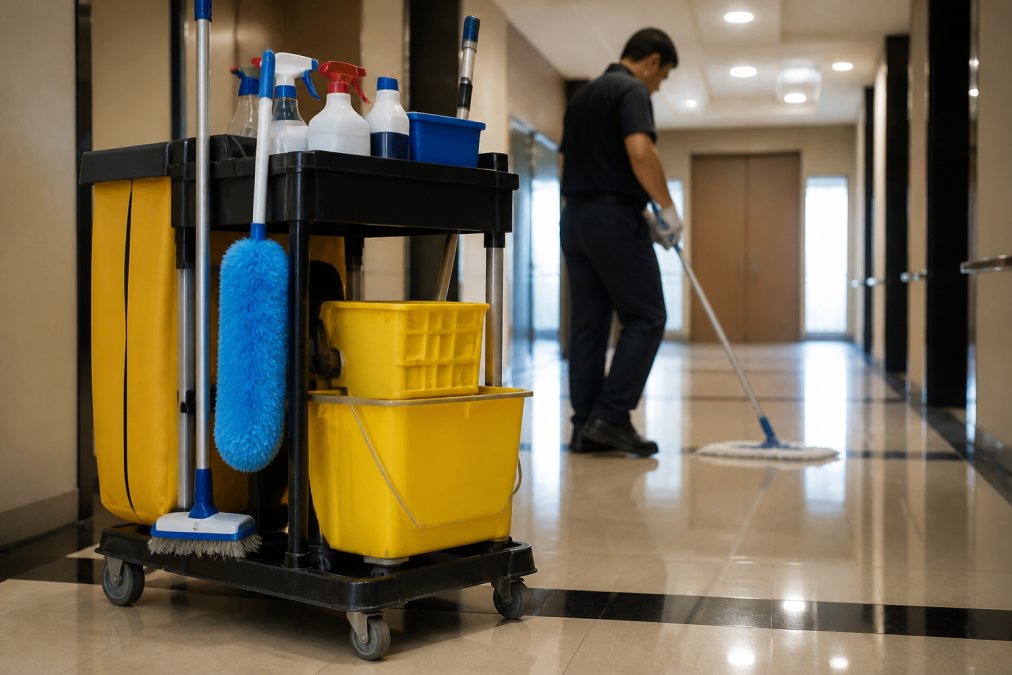
Janitorial services is the broad category of commercial cleaning and facility maintenance work performed on a scheduled or as-needed basis in non-residential settings. The scope ranges from daily trash removal and restroom sanitation to specialized floor care, post-construction cleanup, and industrial disinfection services.
Daily Janitorial and Recurring Custodial Services
Daily janitorial work forms the operational backbone of any commercial cleaning contract. Core recurring custodial services typically include:
- Emptying waste bins and replacing liners
- Vacuuming carpeted areas and sweeping hard floors
- Restroom sanitation, including toilet, sink, and high-touch surface disinfection
- Wiping down desks, countertops, and common surfaces
- Restocking paper products and hand soap
- Spot-cleaning glass and entry doors
- Kitchen and break room cleaning
The frequency of these services depends on facility size, foot traffic volume, and industry. A medical office has very different daily janitorial requirements than a small accounting firm.
Specialized Services: Floor Care, Post-Construction, and Deep Cleaning
Beyond daily custodial work, professional janitorial services include specialized services that require different equipment, training, and scheduling. These are usually quoted separately.
Floor stripping and waxing removes old wax buildup, applies fresh finish coats, and restores the floor's protective layer. It's a preventative maintenance task that extends floor life significantly when done on schedule.
Post-construction cleanup addresses debris, dust, and residue left after renovation or new construction. It typically involves multiple phases: rough cleaning during construction, detailed cleaning after trades finish, and final polish before occupancy.
Deep cleaning addresses accumulated grime in areas that routine custodial services don't reach: behind equipment, inside vents, grout lines, upholstery, and high ledges. Most facilities schedule deep cleaning quarterly or semi-annually.
Types of Facilities That Need Professional Janitorial Services
Professional janitorial services serve many commercial facility types, each with distinct cleaning requirements and compliance considerations.
Office buildings require consistent daily janitorial coverage to maintain workplace hygiene and reduce sick days. Medical and dental offices require higher sanitization standards and must comply with OSHA bloodborne pathogen standards and CDC guidelines. According to CDC guidelines on environmental infection control in healthcare, surface disinfection protocols require specific EPA-registered disinfectants and documented cleaning frequencies.
Retail and hospitality spaces deal with high foot traffic and demanding aesthetic standards. Educational facilities need allergen management and HEPA filtration vacuuming. Industrial and warehouse facilities require crews trained to work around heavy equipment and hazardous materials. Property managers overseeing multi-tenant buildings often need contract cleaning that flexes across different tenant requirements.
The common thread: the cleaning provider must understand the compliance requirements specific to that environment.
Office Carpet Cleaning Services: What Sets Professional Results Apart
Office carpet cleaning services are often misunderstood. Many facilities managers assume regular vacuuming is enough, or that rental machines are reasonable substitutes for professional extraction. Neither assumption holds up in practice.
Why Rental Machines and General Cleaning Fall Short
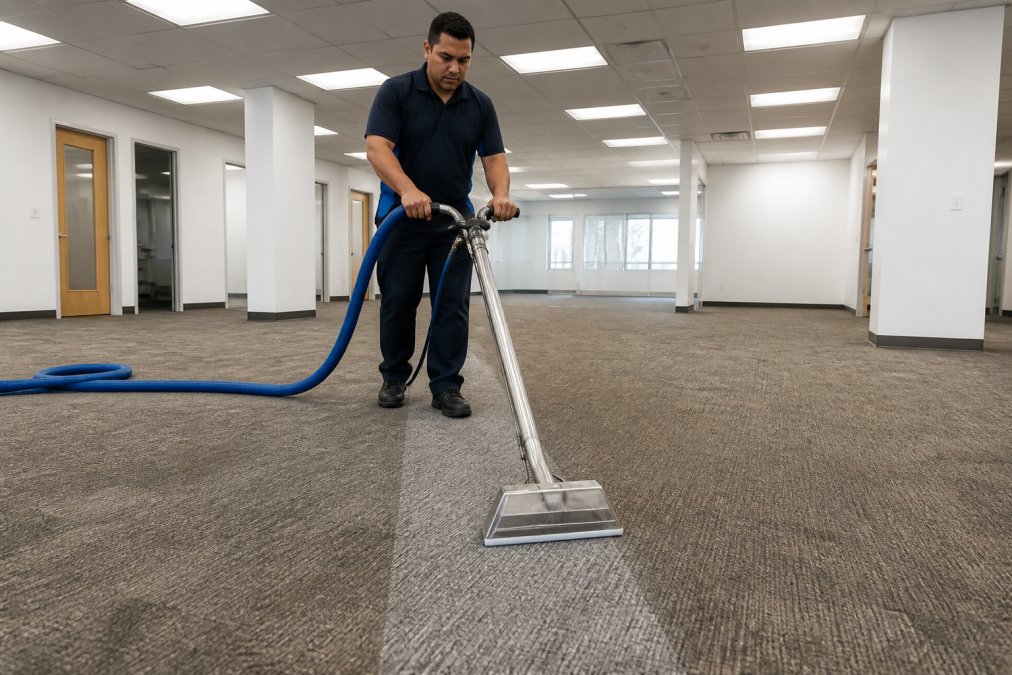
Rental carpet machines lack the water temperature, suction power, and chemical dwell time that professional equipment delivers. The result is carpet that looks cleaner immediately but reabsorbs dirt quickly because extraction was incomplete. General cleaning crews without specialized carpet training compound the problem through incorrect chemistry, over-wetting, and inadequate drying time, which can permanently damage fibers or create conditions for mold growth.
HEPA Filtration, Microfiber Technology, and Carpet Extraction
Professional office carpet cleaning relies on three technical capabilities that rental equipment cannot replicate.
HEPA filtration in commercial vacuums captures particles down to 0.3 microns, including allergens, dust mite debris, and fine particulate matter. For facilities with employees who have respiratory sensitivities, HEPA filtration is a baseline requirement.
Microfiber technology in cleaning cloths captures bacteria and particulate at a microscopic level. Microfiber materials used in professional custodial services are typically laundered and replaced on a documented schedule.
Hot water extraction, commonly called steam cleaning, is the method recommended by most carpet manufacturers for deep cleaning. The Carpet and Rug Institute's commercial carpet maintenance guidelines specifies hot water extraction as the preferred deep-cleaning method for commercial installations.
Janitorial Service Pricing Models Explained
Janitorial service pricing models vary significantly, and the model you agree to impacts your budget predictability and service quality.
| Pricing Model | How It Works | Best For | Watch Out For |
|---|---|---|---|
| Flat monthly rate | Fixed fee for defined scope | Predictable budgets | Scope creep if tasks aren't specified |
| Per-square-foot | Rate based on facility size | Large, uniform spaces | May not account for complexity |
| Hourly rate | Billed by hours worked | Variable or one-time needs | Hard to control total cost |
| Per-service pricing | Quoted per task or visit | Specialized or seasonal work | Can add up quickly without a contract |
Flat monthly rate contracts are most common for recurring commercial cleaning. The provider performs a defined scope for a fixed fee. This works well when scope is clearly documented but creates disputes when tasks are vague.
Per-square-foot pricing is common for large facilities where floor area is the primary variable. Hourly rate agreements give flexibility for non-recurring work but require close oversight. For current pricing, contact providers directly for a site-specific quote.
Commercial Cleaning Contract Checklist: What to Require Before You Sign
A commercial cleaning contract is only as good as what's written in it. Many facility managers sign agreements that look comprehensive but leave out provisions that matter when service quality slips.
Licensing, Bonding, and Insurance Requirements
Any commercial janitorial provider must carry general liability insurance and workers' compensation coverage. Without them, your business bears liability for injuries during cleaning operations.
Bonding protects you against theft or property damage caused by cleaning staff. Background-checked staff is a separate requirement. Ask whether the provider conducts criminal background checks on all employees who access your facility.
According to OSHA's general industry standards for cleaning operations, employers who allow third-party service contractors into their facilities retain responsibility for ensuring those contractors comply with applicable safety standards.
Checklist before signing:
- General liability insurance certificate (minimum $1 million per occurrence)
- Workers' compensation certificate
- Janitorial bond confirmation
- Background check policy for all staff and subcontractors
- Proof of relevant certifications (IJCSA, ISSA, or equivalent)
- Written scope of work with task frequencies
- Service level agreement with measurable quality standards
- Termination clause and notice requirements
- Protocol for reporting damage or service failures
Service Level Agreements and Quality Control Provisions
A service level agreement (SLA) defines the measurable standards your provider is accountable to. Without one, "clean" is entirely subjective.
A well-written SLA should specify:
- Inspection frequency and who conducts site inspections
- How deficiencies are reported and within what timeframe they're corrected
- Key performance indicators such as restroom check frequency or floor care schedule adherence
- Escalation procedures if recurring issues are not resolved
Technology-driven reporting, where supervisors submit real-time inspection data from mobile devices, is increasingly common among professional providers and gives facility managers visibility.
Green Cleaning Standards and Compliance Considerations
Green cleaning refers to documented practices, product standards, and protocols designed to reduce chemical exposure, improve indoor air quality, and minimize environmental impact.
The EPA's Safer Choice program for cleaning products certifies cleaning products that meet strict safety standards for human health and environmental impact. For facilities seeking LEED certification, the rating system includes credits for sustainable cleaning practices, including EPA Safer Choice-certified products, HEPA filtration equipment, and documented custodial training.
Healthcare facilities must balance disinfection efficacy with safe chemical exposure levels. School environments in many states face restrictions on pesticide and cleaning chemical use. Your janitorial provider should understand compliance requirements specific to your industry.
Sustainability credentials worth asking about include IJCSA certification, ISSA CIMS-GB (Green Building) certification, and documented use of concentrated cleaning products that reduce packaging waste.
Why Mighty Clean Services Stands Out for Local Commercial Facilities
Mighty Clean Services has been serving commercial facilities since 2005, bringing years of hands-on experience to office buildings, medical offices, and commercial properties.
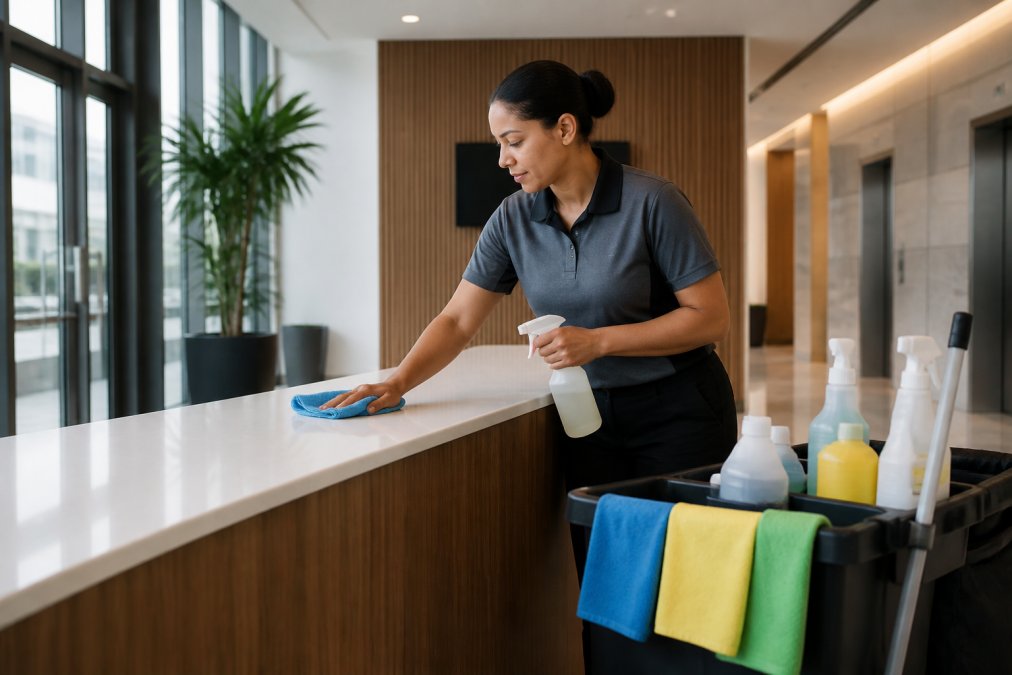
What separates Mighty Clean Services is the combination of certification depth and equipment investment. The team holds IJCSA Janitorial Certification and Water Damage Restoration Certification, along with Mold Inspector and Remediation Certification. These credentials represent verified training standards, not self-reported claims. The International Janitorial Cleaning Association requires documented competency testing for certification.
Mighty Clean Services uses professional-grade carpet extraction and upholstery cleaning equipment, HEPA filtration vacuums, and state-of-the-art cleaning products. This matters most in facilities with carpeted workstations or occupants with respiratory sensitivities, where surface-level cleaning doesn't address contamination below the visible layer.
For commercial facilities needing reliable, certified, and fully insured janitorial services, Mighty Clean Services offers a customer-focused approach built on consistent results. Book an appointment to discuss your facility's specific requirements and get a site-specific quote.
Maintaining a clean, compliant commercial facility requires a cleaning provider with certifications, equipment, and accountability structures. Mighty Clean Services brings IJCSA certification, professional extraction equipment, and a documented track record since 2005 to every commercial engagement. Whether you need recurring custodial services, specialized carpet extraction, or post-construction cleanup, the team is equipped to deliver results that hold up. Book an appointment with Mighty Clean Services and get a scope of work built around your facility's actual requirements.
=== FAQ ANSWERS (audit these too, same rules) ===
[1] Q: What is the difference between janitorial and commercial cleaning? A: Janitorial services refer to routine, recurring tasks performed daily or weekly, emptying trash, restroom sanitation, vacuuming, and surface disinfection. Commercial cleaning typically describes less frequent, deeper work such as floor stripping and waxing, carpet extraction, window washing, or post-construction cleanup. Many providers offer both under a single contract, but it is worth confirming exactly which tasks fall under each category before you sign a service level agreement.
[2] Q: How often should office carpets be professionally cleaned? A: Most commercial facilities benefit from professional carpet extraction every three to six months, depending on foot traffic, the number of employees, and whether food or beverages are consumed in carpeted areas. High-traffic zones such as lobbies and hallways may need attention every eight to twelve weeks. Waiting longer than six months allows soil to bond deeper into carpet fibers, making stains harder to remove and shortening the carpet's usable life.
[3] Q: Are commercial cleaning companies required to be bonded and insured? A: Georgia does not mandate a single statewide license for commercial cleaning companies, but reputable providers carry general liability insurance and a janitorial service bond. The bond protects your business if an employee causes property damage or theft. Always request current certificates of insurance before allowing any cleaning crew on site. IJCSA-certified companies like Mighty Clean Services undergo additional vetting that reinforces these baseline protections.
[4] Q: What should be included in a commercial janitorial contract? A: A solid contract should specify the exact scope of work, cleaning frequency, products used, staff background-check policies, bonding and insurance details, quality control procedures, and the process for requesting extra services. It should also define the service level agreement, including what happens if a scheduled visit is missed. Pricing structure, whether per-square-foot, flat monthly rate, or hourly, should be stated clearly so there are no surprises at billing time.
[5] Q: How much do commercial janitorial services cost? A: Pricing varies based on facility size, cleaning frequency, service type, and local market rates. Common models include per-square-foot rates, flat monthly contracts, and hourly billing. Because no two facilities have identical needs, most reputable providers require a site walkthrough before quoting. Contact Mighty Clean Services directly for a customized estimate that reflects your specific space and service requirements.
Frequently Asked Questions
What is the difference between janitorial and commercial cleaning?
Janitorial services refer to routine, recurring tasks performed daily or weekly, emptying trash, restroom sanitation, vacuuming, and surface disinfection. Commercial cleaning typically describes less frequent, deeper work such as floor stripping and waxing, carpet extraction, window washing, or post-construction cleanup. Many providers offer both under a single contract, but it is worth confirming exactly which tasks fall under each category before you sign a service level agreement.
How often should office carpets be professionally cleaned?
Most commercial facilities benefit from professional carpet extraction every three to six months, depending on foot traffic, the number of employees, and whether food or beverages are consumed in carpeted areas. High-traffic zones such as lobbies and hallways may need attention every eight to twelve weeks. Waiting longer than six months allows soil to bond deeper into carpet fibers, making stains harder to remove and shortening the carpet's usable life.
Are commercial cleaning companies required to be bonded and insured?
Georgia does not mandate a single statewide license for commercial cleaning companies, but reputable providers carry general liability insurance and a janitorial service bond. The bond protects your business if an employee causes property damage or theft. Always request current certificates of insurance before allowing any cleaning crew on site. IJCSA-certified companies like Mighty Clean Services undergo additional vetting that reinforces these baseline protections.
What should be included in a commercial janitorial contract?
A solid contract should specify the exact scope of work, cleaning frequency, products used, staff background-check policies, bonding and insurance details, quality control procedures, and the process for requesting extra services. It should also define the service level agreement, including what happens if a scheduled visit is missed. Pricing structure, whether per-square-foot, flat monthly rate, or hourly, should be stated clearly so there are no surprises at billing time.
How much do commercial janitorial services cost?
Pricing varies based on facility size, cleaning frequency, service type, and local market rates. Common models include per-square-foot rates, flat monthly contracts, and hourly billing. Because no two facilities have identical needs, most reputable providers require a site walkthrough before quoting. Contact Mighty Clean Services directly for a customized estimate that reflects your specific space and service requirements.