 listicle
Hire Professional Carpet Cleaners in 2026: Worth It?
Table of Contents
- Why 2026 Is the Year to Hire Professional Carpet Cleaners
- Rental Machine vs. Professional Service: A Cost-Benefit Analysis
- How Much Does It Cost to Hire Professional Carpet Cleaners? A 2026 Cost Estimator
- What a Certified Service Does That You Can't: Equipment and Technique
- How Long Does Carpet Take to Dry? Comparing Methods
- The Carpet Cleaning Service Checklist: What to Look For Before You Book
- Conclusion: Making the Call for Your Home
- Frequently Asked Questions
Last Updated: September 6, 2026
The decision to hire professional carpet cleaners in 2026 usually comes down to one question: is the cost justified compared to renting a machine yourself? For most households, the answer is yes, but only when you understand what you are actually paying for. Professional carpet cleaning is the process of using commercial-grade extraction equipment and certified techniques to remove deep soil, allergens, and bacteria from carpet fibers. This guide breaks down the real costs, drying times, and outcomes so you can book with confidence instead of guessing.
Many homeowners try a rental machine first, only to find stains reappear within a few months because retail rental units lack the water temperature and suction power of professional systems, leaving detergent residue that attracts new dirt. Below, we show you how to weigh your options, what a certified service provides, and the checklist to use before letting anyone into your home. We have been cleaning carpets since 2005, and the difference between DIY results and professional extraction is often significant.
Why 2026 Is the Year to Hire Professional Carpet Cleaners
The case for booking a professional service this year is stronger than in recent memory. Supply chain pressures have raised the cost of consumer cleaning machines, rental kiosk pricing has crept upward without matching performance gains, and households are spending more hours at home, meaning carpets take heavier foot traffic.
High-traffic areas like hallways, stairs, and living room paths compress dirt deep into the carpet backing where retail machines cannot reach it. A rental unit typically sprays solution onto the surface and extracts only the top layer, leaving the lower pile saturated. Professional hot water extraction pushes cleaning solution through the full carpet depth and pulls it back out with industrial-strength suction, which is the only method that genuinely resets the carpet.
Rental Machine vs. Professional Service: A Cost-Benefit Analysis
Comparing a rental machine to a professional service goes beyond the sticker price. A rental costs less upfront, but you must factor in your own labor, the risk of damage from over-wetting, and the likelihood of needing a repeat cleaning sooner. Professional service costs more per visit but typically extends the time between deep cleanings and protects the carpet warranty.
The cost-benefit analysis changes depending on your situation. A single small rug with a fresh stain might justify a rental; a home with pets, children, or allergy sufferers almost always benefits more from professional extraction. Consider what your time is worth: a rental requires you to move furniture, operate the equipment, and manage drying for an entire day, while a professional team handles all of that.
| Factor | Rental Machine | Professional Service |
|---|---|---|
| Upfront cost | Lower | Higher |
| Time required | Full day of labor | 1-2 hours supervised |
| Suction power | Moderate | Commercial-grade |
| Water temperature | Limited | High-heat extraction |
| Residue left behind | Common | Minimal |
| Warranty protection | Risk of voiding | Usually compliant |
| Best for | Spot cleaning, small areas | Full-home deep cleaning |
How Much Does It Cost to Hire Professional Carpet Cleaners? A 2026 Cost Estimator
Pricing for professional carpet cleaners in 2026 is not a single number, it depends on your home's layout, the carpet's condition, and the services you request. National averages for a full-home cleaning can vary, but that range is only a starting point. A more useful way to budget is to break the quote down by the line items that drive the price.
Most professional services price by the room or by square footage. A common pricing model is per-room or by square footage. Hallways and stairs are almost always billed separately. Heavily soiled carpets or those with pet urine contamination can require additional pre-treatment passes and longer extraction cycles, which may affect the rate.
Add-on services are where quotes diverge significantly between providers. Upholstery cleaning is typically priced per piece. Stain treatments for set-in spots like wine, coffee, or pet accidents may vary depending on the specialized spotting agent or extraction method required. Sanitization treatments are popular for homes with allergy sufferers. Pet odor treatments that require enzyme-based solutions and multiple applications are often the most comprehensive add-on.
Geographic location plays a significant role in pricing. Geographic location plays a significant role in pricing. The best way to get an accurate estimate is an in-home assessment, where the technician measures actual square footage, inspects the carpet fiber type, and identifies high-traffic zones. A phone quote that does not ask about your carpet type, pets, or set-in stains is a red flag.
For a precise estimate tailored to your home's specific measurements and carpet condition, contact Mighty Clean Services. Our certified team conducts a thorough in-home assessment and provides a written, itemized quote that lists every service before any work begins. The Institute of Inspection, Cleaning and Restoration Certification offers guidance on what professional cleaning should include
What a Certified Service Does That You Can't: Equipment and Technique
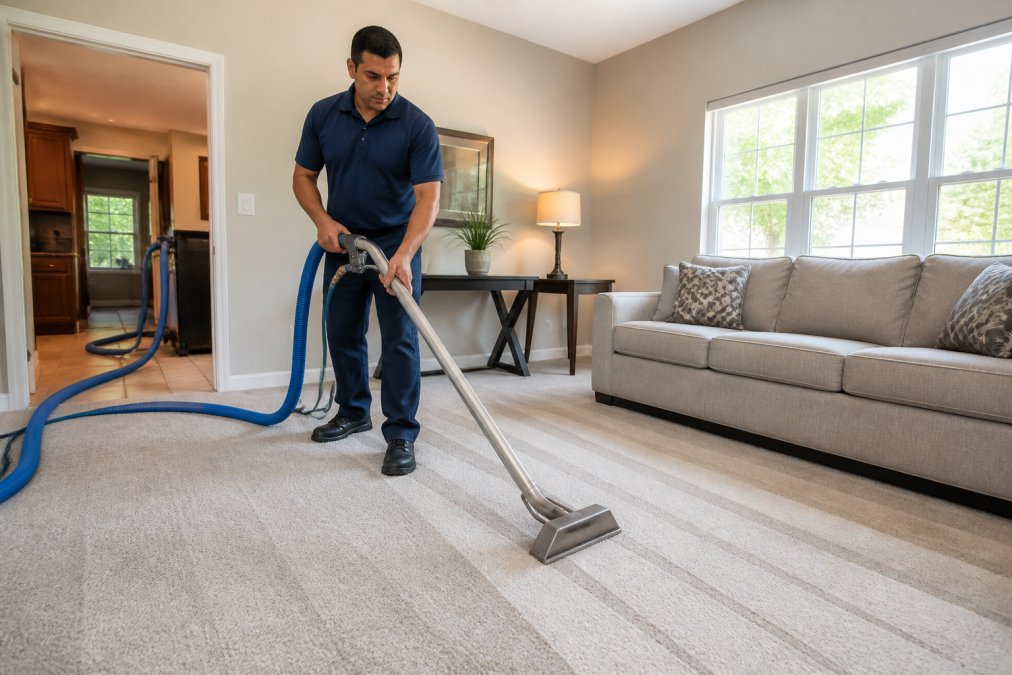
The equipment gap between rental units and professional services comes down to measurable performance in water temperature, suction power, and solution delivery. Rental machines operate on a standard 120-volt circuit, limiting their heating element to roughly 130°F to 150°F, which cannot break down oily soils or waxy residue. Professional truck-mounted systems generate water temperatures between 200°F and 230°F, hot enough to emulsify those oils and sanitize fibers without damaging the backing.
Suction power is the second major differentiator. Rental units typically pull 50 to 100 inches of water lift, leaving the lower pile saturated, while professional truck-mounted systems generate 150 to 200 inches, pulling water and detergent from the base of the fibers. This is why a rental-cleaned carpet can feel damp for 12 to 24 hours, while a professional cleaning dries in 4 to 6 hours. Stronger suction also prevents over-wetting that can lead to mold growth in the padding, a problem that is expensive to fix and often not covered by warranty.
Certification matters because it verifies that the technician understands the interaction between cleaning chemistry and carpet fiber type. Nylon, polyester, olefin, and wool each require different pH levels and solution concentrations. A technician trained by the IJCSA or IICRC knows that a high-pH solution can cause browning on wool, while an overly acidic solution can dull nylon's color. That training protects your carpet from over-wetting and discoloration.
The most overlooked consequence of DIY cleaning is its impact on your carpet warranty. Most major manufacturers, including Shaw, Mohawk, and Stainmaster, require cleaning methods that meet the Carpet and Rug Institute's (CRI) Seal of Approval standards, which mandate specific temperature, pressure, and extraction times. Rental machines rarely meet these standards, and the CRI states that non-approved methods or solutions can void the warranty. If a DIY cleaning leaves residue that attracts dirt or discolors the carpet, the manufacturer can deny a claim. Professional services using CRI-approved equipment provide documentation that satisfies warranty conditions.
A professional service also brings the right tools for edge cases. An upholstery attachment cleans furniture without over-saturating the fabric. A power wand with a clear window lets the technician see when the water runs clear, confirming full extraction. A pre-spray applicator ensures even solution coverage. These details are invisible in a rental kiosk but make the difference between a carpet that looks clean and one that is clean to the backing.
How Long Does Carpet Take to Dry? Comparing Methods
Drying time is one of the most practical concerns for homeowners, especially those who work from home or have young children. The answer depends entirely on the method and the equipment's extraction power. Rental machines typically leave carpets damp for 12 to 24 hours because weaker suction leaves more moisture in the pile. Professional truck-mounted extraction removes more water, so carpets are usually dry within 4 to 6 hours.
Several factors influence drying time beyond the equipment itself. Carpet thickness plays a role, as dense pile holds more moisture. Indoor humidity and airflow matter significantly, which is why professional services often recommend running ceiling fans and opening windows after cleaning. Some services offer a "dry-in-one-hour" option using low-moisture encapsulation, though this method does not provide the same deep extraction as hot water cleaning.
The Carpet Cleaning Service Checklist: What to Look For Before You Book
Before you commit to any provider, run through a checklist that separates qualified professionals from operators with a van and a wand. Start with certification and insurance. A certified technician has demonstrated knowledge of proper cleaning methods, and insurance protects you if damage occurs. Ask which certifying body issued their credential and verify it independently.
Next, question the process. A professional should ask about your carpet type, any existing stains, and whether you have pets or allergy sufferers in the home. That information determines which cleaning solutions are safe and effective. A service that quotes a price without asking these questions is not doing a proper assessment. The Carpet and Rug Institute explains how proper maintenance protects your carpet warranty
The checklist continues with equipment and solutions. Confirm that the service uses truck-mounted or high-end portable extraction equipment, not a residential unit. Ask whether their cleaning solutions are safe for children and pets once dry. Finally, review the drying time estimate and what happens if stains do not fully lift. A confident service sets honest expectations rather than promising perfection on every stain.
- Verify IJCSA or equivalent certification and current insurance
- Confirm truck-mounted or commercial-grade extraction equipment
- Ask about solution safety for pets, children, and allergy sufferers
- Request a written quote that itemizes rooms, stairs, and treatments
- Clarify expected drying time and post-cleaning ventilation needs
- Ask how the service handles set-in stains that resist first treatment
Conclusion: Making the Call for Your Home
Choosing between a rental machine and a professional service comes down to your carpet's condition, your available time, and whether you want results that last. Rental units work for small, surface-level jobs, but they cannot match the extraction power, drying speed, and long-term carpet health of certified professional equipment. If your carpets see regular foot traffic, host pets or children, or have stains that keep returning, the professional route is the better investment.
Mighty Clean Services has provided certified residential and commercial carpet care since 2005. Our IJCSA-certified team uses state-of-the-art extraction equipment to remove stains, allergens, and odors. We handle everything from upholstery cleaning to move-in and move-out services, and we back our work with a customer-focused process from start to finish. The Environmental Protection Agency offers guidance on indoor air quality and allergen reduction
Book an appointment with Mighty Clean Services and see the difference that certified, professional extraction makes in your home.
Frequently Asked Questions
How much does it cost to hire professional carpet cleaners in 2026?
Pricing varies based on square footage, soil level, and any specialty treatments like pet stain removal or upholstery cleaning. Most companies quote per room or per square foot. For an exact figure, contact Mighty Clean Services for a free, no-obligation quote tailored to your home.
Is professional carpet cleaning better than renting a machine?
Yes, for most situations. Rental machines from grocery stores use lower water pressure and suction power. They often leave behind soapy residue that attracts dirt, causing stains to reappear quickly. Professional systems use hot water extraction with industrial-strength suction, removing more soil and cleaning solutions in a single pass. This means carpets dry faster and stay cleaner longer.
How long does carpet take to dry after professional cleaning?
With professional hot water extraction, carpets typically dry within 4 to 6 hours when using a truck-mounted unit and proper air circulation. This is much faster than rental machines, which can leave carpets damp for 12 to 24 hours. To speed up drying, open windows, run ceiling fans, and turn on your HVAC system. A professional service will also do a final extraction pass to remove excess moisture.
What certifications should I look for when hiring carpet cleaners?
Look for certifications from recognized industry bodies like the International Janitorial Cleaning Association (IJCSA) or the Institute of Inspection, Cleaning and Restoration Certification (IICRC). These credentials show the company trains its staff on proper cleaning techniques, equipment use, and safety standards. Mighty Clean Services is IJCSA-certified for janitorial, water damage restoration, and mold remediation, ensuring a high level of expertise.
How often should you have carpets professionally cleaned?
The general recommendation is every 12 to 18 months for most homes. However, households with pets, children, or allergy sufferers should schedule a professional deep-cleaning every 6 to 12 months. High-traffic areas and homes with heavy soil may need more frequent service. Regular cleaning removes embedded dirt and allergens that vacuuming misses, extending the life of your carpet and helping to maintain your carpet warranty.