 how-to
Carpet Cleaning for Humidity Damage: 2026 Guide
Table of Contents
- Why Humidity Turns Carpet Cleaning Into a Race Against Time
- How to Dry Carpet After Cleaning: A Step-by-Step Process
- Signs of Mold in Carpet You Should Never Ignore
- Does a Dehumidifier for Carpet Moisture Actually Speed Up Drying?
- Which Carpet Fibers and Backings Handle Humidity Best
- Moisture-Safe Cleaning Solutions for Humid Climates
- Preventing Humidity Damage Between Professional Cleanings
- Frequently Asked Questions
Last Updated: September 16, 2026
Why Humidity Turns Carpet Cleaning Into a Race Against Time
Carpet cleaning for humidity damage is a race against the clock: the longer moisture sits in the backing and padding, the more likely mold spores are to colonize the fibers. High relative humidity slows evaporation, so a carpet that dries in six hours under dry conditions can stay damp for two days when the air is already saturated. Since 2005, we have been dedicated to delivering high-quality results by prioritizing our customers' needs and utilizing state-of-the-art equipment.
How to Dry Carpet After Cleaning: A Step-by-Step Process
The goal is to move from fiber saturation to fully dry backing in under 12 hours. Here is a recommended sequence.
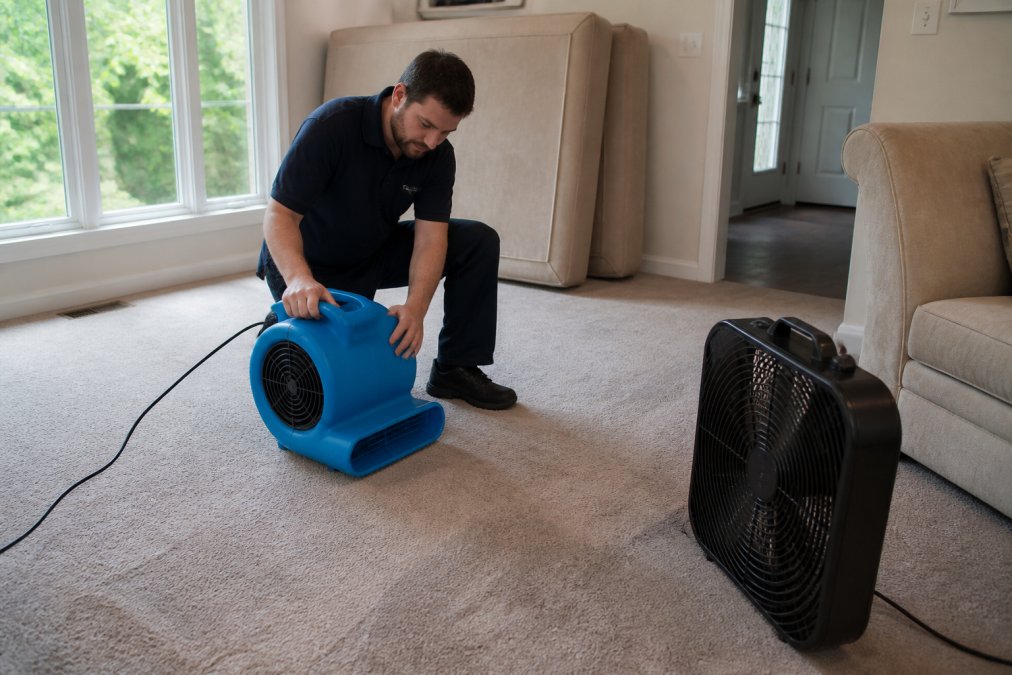
- Extract standing water immediately. Pass a wet vacuum or extraction wand over the carpet in overlapping strokes until no water rises.
- Lift the carpet edge if the pad is soaked. Padding holds most of the moisture and must be dried separately or replaced.
- Position air movers at a 45-degree angle. Aim airflow across the surface, not straight down, to lift moisture off the fibers.
- Run a dehumidifier in the same room. Air movers alone just relocate moisture into the air; a dehumidifier pulls it out.
- Set the HVAC to cool and fan-on. Cool air holds less moisture, and continuous fan circulation prevents damp pockets from forming.
- Check the backing and pad with a moisture meter. Do not stop at surface drying. Test at the base of the fibers.
- Keep foot traffic off until readings are consistent. A carpet that feels dry can still be saturated underneath.
Emergency Extraction: When Water Is Still Sitting in the Pad
If a towel pressed into the carpet comes back wet, the pad is still holding water a standard wet vacuum will not reach. Pull the carpet back at a corner, remove the saturated pad, and dry both layers separately. Skipping this step is the most common reason a carpet smells musty a week after cleaning.
Signs of Mold in Carpet You Should Never Ignore
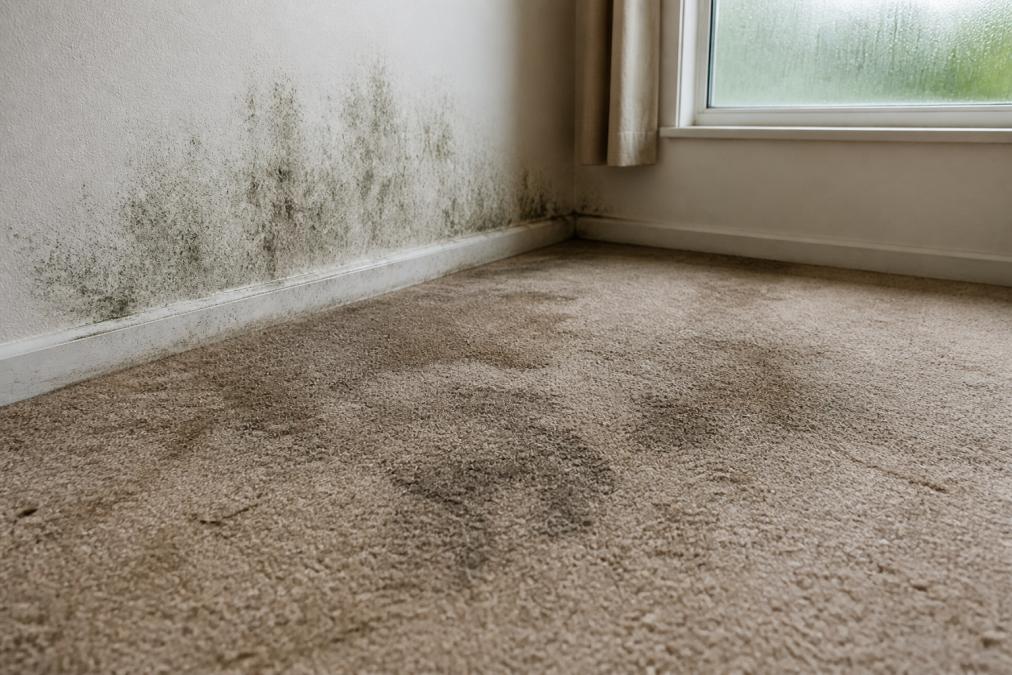
Mold in carpet shows up as discoloration, a persistent musty odor, or dark spotting near the base of the fibers and along the tack strip. These signs appear faster in humid climates because mold spores need only moisture and a food source, both of which a damp carpet provides.
Watch for these indicators:
- A musty, earthy smell that returns after vacuuming
- Dark or greenish-black speckling along carpet edges and under furniture
- Discolored patches that do not lift with cleaning
- Allergy symptoms that worsen in one specific room
- Carpet that feels damp or cool to the touch days after cleaning
Does a Dehumidifier for Carpet Moisture Actually Speed Up Drying?
A dehumidifier for carpet moisture works because drying is a two-part problem. Air movers increase evaporation from the carpet surface into the air; a dehumidifier removes that vapor so the carpet has somewhere to keep evaporating into. Run only air movers and you saturate the room's air within an hour or two, at which point evaporation slows to a crawl.
Sizing the Dehumidifier to the Room
Undersizing is the most common failure. As a working rule, a 30-pint refrigerant dehumidifier suits a single small room, while larger open-plan spaces or multiple affected rooms call for a 50-pint or 70-pint unit. Below roughly 65°F, a refrigerant unit's coils frost and output drops sharply, a desiccant dehumidifier performs better in cool conditions, which matters for basements and rooms with the AC cranked low.
Placement and Airflow Setup
- Put the dehumidifier in the center of the room, not against a wall, so it draws from all directions.
- Keep interior doors open so it can pull from adjacent spaces, but close exterior doors and windows so you are not dehumidifying the neighborhood.
- Aim air movers at a 45-degree angle across the carpet surface so they push the saturated boundary layer toward the dehumidifier's intake.
- Do not box the unit in behind furniture or curtains; restricted intake airflow cuts its effective capacity.
- Drain continuously to a floor drain or sink if the unit supports a hose. A unit that shuts off on a full tank overnight undoes hours of progress.
Monitoring: When to Stop
Do not judge dryness by touch. A hygrometer at the carpet surface tells you the relative humidity directly above the fibers, and a moisture meter tells you what is happening in the backing and pad. Keep surface-level relative humidity in the 40-50% range during drying; once readings stabilize there and the moisture meter matches a dry reference area, you can stop.
What a Dehumidifier Cannot Fix
A dehumidifier removes water vapor from the air; it does not extract liquid water from carpet or padding. If a towel pressed into the carpet comes back wet, no amount of dehumidification will finish the job, you need extraction first, and possibly pad removal. The dehumidifier is the second half of the drying process, not a substitute for the first.
Which Carpet Fibers and Backings Handle Humidity Best
Most guides treat every carpet the same when it comes to humidity, which is why so many people ruin a wool rug by treating it like nylon. The fiber and backing determine how fast a carpet dries, how much water it holds, and whether it survives a slow dry without permanent damage.
Why Fibers Behave Differently
The key property is moisture regain, how much water a fiber absorbs from the air relative to its own weight, and how tightly it holds it. Synthetic fibers are hydrophobic: moisture sits on the surface and between fibers rather than inside them. Natural fibers are hydrophilic: they absorb water into the fiber structure itself, so they swell, stay damp longer, and can support mold growth from within.
| Fiber or Backing | Moisture Behavior | Humidity Risk | Best For |
|---|---|---|---|
| Nylon | Low absorption, fast drying, resilient when wet | Low | High-traffic, humid rooms |
| Polyester | Resists moisture, dries fast, less resilient | Low | Bedrooms, living areas |
| Olefin (polypropylene) | Does not absorb water, dries very fast | Low | Basements, damp spaces |
| Wool | Absorbs and holds moisture, can felt or shrink | High | Dry climates, low traffic |
| Jute backing | Absorbs water readily, slow to dry | High | Avoid in humid rooms |
| Rubber backing | Blocks moisture, traps it below | Moderate | Areas with spill risk |
Synthetic Fibers: The Humidity-Tolerant Default
Nylon, polyester, and olefin are the practical choice for humid homes because they dry quickly and resist microbial growth. Nylon is the most resilient when wet and holds up to repeated extraction, which is why it dominates high-traffic commercial carpet. Polyester resists moisture well but crushes easily when wet, so keep heavy furniture off a damp polyester carpet until it is fully dry.
Natural Fibers: High Sensitivity, High Stakes
Wool is the fiber most people get wrong. It can absorb a significant percentage of its own weight in water without feeling wet, so a wool carpet can be far damper than it appears. Wool also felts and shrinks when heat, agitation, and moisture combine, the exact combination a hot water extraction pass delivers. In a humid environment, a wool carpet that does not dry completely within a day or so risks mold growth inside the fiber, odor that will not come out, and permanent texture change.
Backing Matters as Much as Fiber
The backing is where humidity damage usually starts, because it is the layer you cannot see or feel. Jute backing wicks and holds water and should be avoided in humid rooms. Rubber and other impermeable backings block moisture from the subfloor but can trap dampness underneath, creating a hidden mold reservoir. Woven or breathable backings dry faster but protect the subfloor less.
Humidity-Specific Recovery Guidance
- Synthetic carpet, light moisture: Air movers plus a dehumidifier will usually finish it within 6-12 hours. Monitor the backing with a moisture meter.
- Synthetic carpet, saturated pad: Extract, then lift the carpet edge and dry or replace the pad. Synthetics tolerate this well.
- Wool carpet, any significant moisture: Use low-moisture methods, dry compound or encapsulation, rather than hot water extraction. Dry with cool air, not heat, and never agitate a damp wool carpet.
- Natural-fiber rug with jute backing: If it is soaked, professional drying or replacement is usually the only reliable option. DIY drying rarely reaches the jute layer.
Carpet and Rug Institute fiber and cleaning guidance outlines fiber-specific cleaning recommendations that align with these humidity considerations.
Moisture-Safe Cleaning Solutions for Humid Climates
Cleaning solutions for humid climates should leave as little residual moisture as possible. Many shampoos and foams add water and leave surfactant residue behind, which attracts dirt and holds moisture, exactly what you do not want when the air is already damp.
Choose low-moisture methods:
- Hot water extraction with a controlled pass and immediate extraction
- Encapsulation cleaning, which crystallizes residue for later vacuuming
- Dry compound cleaning for delicate or natural-fiber carpets
- pH-balanced, low-residue solutions that rinse clean
Preventing Humidity Damage Between Professional Cleanings
- Run a dehumidifier or the AC during humid stretches to hold indoor relative humidity down
- Keep HVAC fan settings on circulate to maintain airflow
- Blot spills immediately and dry the area with a fan
- Vacuum regularly to cut allergen buildup and lift trapped moisture-holding debris
- Schedule deep cleaning before humid seasons, not during them
- Inspect carpet near doors, windows, and bathrooms where condensation collects
For stubborn cases, professional extraction removes moisture the average rental machine cannot reach. Mighty Clean Services uses state-of-the-art cleaning equipment. Our IJCSA-certified team is committed to ensuring your space looks its absolute best.
Frequently Asked Questions
How long can carpet stay wet before mold starts growing?
Most mold spores need 24 to 48 hours of sustained dampness to colonize carpet fibers and padding. In a room sitting at 70% relative humidity or higher, that window shrinks. If the carpet still feels damp after a full day, treat it as an active moisture problem: increase air circulation, run a dehumidifier, and check the padding. Carpet that stays wet longer than two days usually needs professional extraction, since surface drying alone leaves moisture trapped in the backing and subfloor.
Can mold grow in carpet even after it has been cleaned?
Yes. Cleaning adds water, and if the carpet does not dry fast enough, mold spores that were already present can bloom. After any deep cleaning, keep indoor relative humidity below 60%, run fans or your HVAC system, and watch for musty odors. A hygrometer reading above 60% in the room is your cue to add dehumidification.
What are the early signs of humidity damage in carpet?
Watch for a musty odor that returns within days of cleaning, dark or discolored patches near baseboards, carpet that feels cool or clammy underfoot, and visible wicking along the edges of the room. Delamination, where the backing separates from the fibers, is a later sign that water has reached the subfloor. If you notice any of these, run a dehumidifier and schedule a professional inspection before the damage spreads to the padding and subfloor.
How do I dry carpet faster after cleaning in a humid climate?
Start with extraction, not airflow. A wet vacuum or professional steam extraction removes the bulk of the water before fans ever touch it. Then run high-velocity air movers across the surface, open interior doors to improve air circulation, and set your HVAC to a cool, dry setting. A dehumidifier for carpet moisture pulls water vapor out of the air so it cannot settle back into the fibers. Most carpets dry in 6 to 12 hours with this combination; without dehumidification, it can take more than a day.