 ultimate-guide
How Often to Clean Commercial Carpets: A 2026 Guide
Table of Contents
- The Real Cost of Skipping Your Commercial Carpet Cleaning Schedule
- How Often to Clean Commercial Carpets by Traffic Zone
- Building a Commercial Carpet Maintenance Schedule That Works
- Interim vs Restorative Carpet Cleaning: Which Does Your Facility Need?
- Signs Your Commercial Carpet Needs Immediate Attention
- Why Professional Commercial Janitorial Services Extend Carpet Life
- Preventative Maintenance: Mats, Spot Removal, and Daily Habits
- Conclusion: Set Your Schedule and Stick to It
- Frequently Asked Questions
Last Updated: September 8, 2026
The Real Cost of Skipping Your Commercial Carpet Cleaning Schedule
Every day a commercial carpet goes without proper cleaning, soil embeds deeper into the fiber, grinding away at the pile like sandpaper under foot traffic. The visible result is dull, matted carpet that ages years ahead of schedule; the hidden result is a facility that feels unclean no matter how often the trash is emptied.
Most facility managers know they should clean commercial carpets more often than they do. The question is how often to clean commercial carpets in a way that balances budget, appearance, and lifespan. Skipping scheduled cleanings to save money short-term almost always guarantees a premature replacement cost that dwarfs any cleaning invoice.
Below, we walk through specific schedules by traffic zone, the difference between interim and restorative cleaning, and the warning signs that your current plan is failing.
How Often to Clean Commercial Carpets by Traffic Zone
Cleaning frequency should be driven by one factor above all others: the volume of foot traffic a zone receives. A carpet in a quiet executive suite and one in a main lobby experience completely different soil loads and need different schedules to stay healthy. The most effective way to clean commercial carpets is to divide your facility into zones and assign each a cadence based on traffic.
The Carpet and Rug Institute's guidelines on commercial carpet maintenance recommend a tiered approach that matches cleaning intensity to traffic patterns. This prevents both the waste of over-cleaning low-traffic areas and the damage of under-cleaning busy ones.
High-Traffic Zones: Entrances, Lobbies, and Corridors
Entrances, lobbies, and main corridors absorb the majority of soil brought in from outside. These high-traffic zones typically need professional extraction cleaning every 3 to 6 months, with the first 15 to 20 feet inside every entrance protected by walk-off matting. Many facilities find a monthly interim cleaning using encapsulation or bonnet cleaning keeps appearance acceptable between deeper extractions.
Moderate-Traffic Zones: Offices and Conference Rooms
Offices, conference rooms, and other moderate-traffic areas accumulate soil more slowly. A professional deep cleaning every 6 to 12 months is usually sufficient, provided they receive consistent daily vacuuming. Conference rooms hosting frequent catered events may need the high-traffic schedule, since food spills and increased traffic accelerate soiling.
Industry-Specific Schedules: One Size Does Not Fit All
While traffic volume is the primary driver, the type of business operating in the space dictates the soil load and required response. A general schedule is a starting point, but facility managers should calibrate it to their industry's risks and regulatory environment.
- Healthcare Facilities (Medical Offices, Clinics, Senior Care): These environments demand a more aggressive schedule due to infection control concerns and the presence of vulnerable individuals. High-traffic patient areas and waiting rooms often require restorative hot water extraction every 1 to 3 months, not just quarterly. Spills of bodily fluids require immediate professional sanitization, not just spot cleaning. The CDC guidelines for environmental infection control highlight the importance of regular cleaning and disinfection of surfaces, and carpet in these settings must be maintained to a higher standard to prevent harboring pathogens.
- Retail Stores and Showrooms: The primary goal here is aesthetic appeal, as stained or matted carpet directly impacts the customer experience and sales. High-traffic sales floors typically need interim cleaning (encapsulation) monthly and restorative extraction every 3 to 6 months. The frequency should increase during peak shopping seasons like the winter holidays. A common pattern is to schedule deep cleanings after major sales events to restore the showroom's appearance.
- Corporate Offices and Professional Services: These environments typically have lower soil loads but a high expectation for a clean, professional appearance. Standard schedules of daily vacuuming, quarterly interim cleaning, and semi-annual restorative extraction are usually sufficient. However, areas near breakrooms or kitchens should be treated as high-traffic zones due to the high risk of spills and the attraction of pests.
- Educational Institutions (K-12, Universities): Schools face a unique combination of heavy traffic, spills, and a need for indoor air quality management. Classrooms and hallways often require restorative cleaning every 3 to 6 months, with daily vacuuming being non-negotiable. The schedule must also account for long breaks (summer, winter) which are ideal for deep, restorative cleanings that allow for extended drying times.
Building a Commercial Carpet Maintenance Schedule That Works
A commercial carpet maintenance schedule is only useful if it is written down, assigned to specific people, and tracked. A verbal agreement to "vacuum regularly" will fail within weeks. The most reliable approach is a documented plan separating daily upkeep from periodic deep cleaning, with clear ownership for each task.
Daily Vacuuming Frequency
Vacuuming is the single most important step in extending carpet life, yet it is the most frequently skipped. High-traffic areas should be vacuumed daily, and in very busy facilities, multiple times per day; moderate-traffic offices can be vacuumed two to three times per week. The goal is to remove dry soil before foot traffic grinds it into the fiber. A common mistake is using a vacuum with worn brushes or a full bag, which redistributes dirt rather than removing it.
Quarterly vs. Semi-Annual Deep Cleaning
For deep cleaning, most commercial facilities fall into one of two schedules. Quarterly cleaning (every 3 months) suits buildings with continuous public access, such as medical offices, retail stores, and schools. Semi-annual cleaning (every 6 months) works for standard office environments with controlled access. The EPA guidance on indoor air quality in commercial buildings notes that carpets act as a filter for airborne particles, which means regular deep cleaning also supports better indoor air quality for occupants.
Interim vs Restorative Carpet Cleaning: Which Does Your Facility Need?
Many facility managers assume all deep cleaning is the same. In practice, interim vs restorative carpet cleaning describes two different goals. Interim cleaning refreshes carpet appearance between deep cleanings without removing heavy soil embedded deep in the backing; it typically uses low-moisture methods like encapsulation and is performed more frequently, often quarterly.
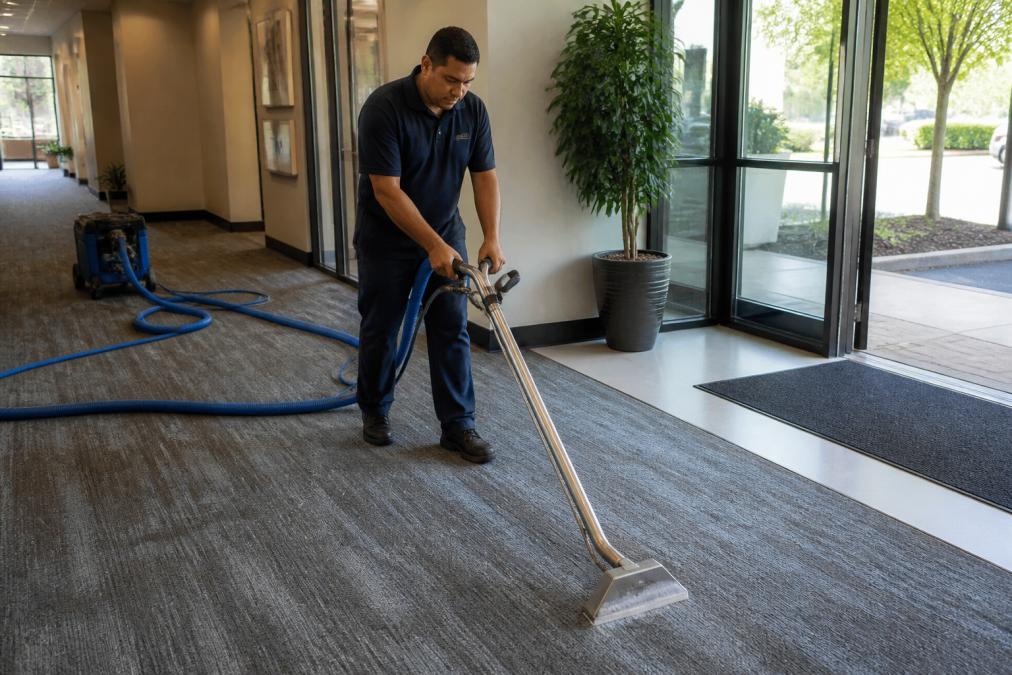
Restorative cleaning, by contrast, is the deep extraction process that removes accumulated soil, residue, and contaminants from the entire carpet structure. This hot water extraction method, often called steam cleaning, should be performed semi-annually or annually depending on traffic. It returns the carpet to a near-original state and is required to prevent fiber degradation and meet most warranty requirements.
The table below summarizes when each method should be used:
| Cleaning Type | Frequency | Best Method | Primary Purpose |
|---|---|---|---|
| Daily Vacuuming | Daily to 3x weekly | Dry vacuum | Remove surface grit |
| Interim Cleaning | Every 3-6 months | Encapsulation or bonnet | Refresh appearance |
| Restorative Cleaning | Every 6-12 months | Hot water extraction | Remove deep soil and residue |
Signs Your Commercial Carpet Needs Immediate Attention
Your maintenance schedule is a starting point, not a substitute for observation. Traffic lanes that appear darker or more matted than surrounding carpet signal that soil has become embedded and is actively damaging the pile. Persistent odors, even after vacuuming, suggest spills have penetrated to the backing and require extraction.
Visible spots or stains that reappear after cleaning may indicate residue left behind by previous methods or incomplete extraction. A carpet that feels rough or stiff underfoot has likely accumulated significant soil. If occupants report worsening allergy symptoms or you notice a musty smell, the carpet may harbor moisture or biological growth requiring prompt professional sanitization.
Why Professional Commercial Janitorial Services Extend Carpet Life
Attempting to manage commercial carpet care with residential equipment or rental machines rarely delivers acceptable results. Commercial janitorial services use truck-mounted or commercial-grade extraction units that operate at higher water temperatures and stronger suction than consumer machines, removing more soil and leaving carpet significantly drier, reducing the risk of mold and mildew.
Professional providers like Mighty Clean Services, certified by the International Janitorial Cleaning Association (IJCSA), bring more than equipment to the job. A trained technician understands how to adjust cleaning methods for different carpet fibers, how to pretreat high-soil zones, and how to avoid over-wetting that can cause delamination or shrinkage. The Institute of Inspection, Cleaning and Restoration Certification standards define the proper procedures for professional carpet cleaning, and hiring a certified provider ensures those standards are met.
The Financial Case: Cleaning is an Investment, Not an Expense
The most compelling reason to hire a professional is not just appearance, it's the return on investment (ROI). Commercial carpet is a significant capital asset. A typical commercial-grade carpet can cost between $3 and $6 per square foot installed. For a 10,000-square-foot facility, that is a $30,000 to $60,000 asset. The goal of maintenance is to protect that asset for its full useful life.
Industry data from organizations like the Carpet and Rug Institute suggests a well-maintained carpet can last 10 to 15 years, while a neglected one may need replacement in as little as 5 to 7 years. Consider:
- Scenario A (Neglect): A 10,000 sq ft carpet fails in 6 years. The replacement cost is $50,000 (at $5/sq ft). The annualized cost of the carpet is over $8,300 per year.
- Scenario B (Professional Maintenance): The same carpet lasts 12 years. The annualized cost drops to roughly $4,200 per year.
The difference is over $4,000 per year in avoided capital expenditure. A professional cleaning contract for a space this size might cost between $2,000 and $5,000 per year, depending on frequency. In this model, the cleaning service pays for itself by extending the asset's life and deferring the massive capital outlay of replacement.
DIY vs. Outsourced: A Cost-Benefit Analysis
For some facilities, the question isn't whether to clean, but whether to buy equipment and do it in-house. While a commercial-grade extractor can be purchased for $3,000 to $8,000, this approach has hidden costs that often make it less economical than it appears.
| Factor | In-House (DIY) | Outsourced Professional |
|---|---|---|
| Equipment Cost | High initial capital outlay ($3k-$8k+). | No capital outlay; cost is per-service. |
| Labor & Training | Staff time is diverted from core duties. Requires training on proper extraction techniques to avoid over-wetting and damage. | No training required; technicians are certified and experienced. |
| Maintenance & Repairs | You are responsible for upkeep, repairs, and eventual replacement of the machine. | Provider handles all equipment maintenance. |
| Chemicals & Supplies | You must purchase, store, and manage cleaning solutions. | Included in the service price. |
| Insurance & Liability | You assume liability for any damage caused by improper cleaning (e.g., delamination, shrinkage). | Professional providers carry liability insurance to cover accidental damage. |
| Time to Dry | Consumer and even some commercial units have lower suction, leading to longer dry times and potential for mold. | High-powered truck-mounted units offer superior suction, reducing dry times. |
| Scalability | Difficult to scale for large facilities or multiple locations. | Easily scalable to cover any size or number of locations. |
Facilities with less than 5,000 square feet of carpet typically find it more cost-effective to outsource. Those with larger areas may consider in-house cleaning, but must factor in the full cost of labor, training, and equipment lifecycle. Even then, many large facilities opt for a hybrid model: in-house staff handle daily vacuuming and spot removal, while a professional service handles quarterly and restorative deep cleaning to ensure warranty compliance and asset protection.
Preventative Maintenance: Mats, Spot Removal, and Daily Habits
The most cost-effective cleaning is the soil that never reaches your carpet. Preventative maintenance starts with a strong matting system. Walk-off mats at every exterior entrance should extend a minimum of 15 feet into the building to capture the majority of tracked-in soil. These mats require their own cleaning schedule, as a saturated mat becomes a source of moisture and dirt rather than a barrier.
Daily spot removal is equally critical. The longer a spill sits, the harder it is to remove, and many permanent stains result from delayed response. Train staff to blot spills immediately with a clean white cloth and to notify your cleaning provider about any stain requiring professional attention. Never rub a spill, as this pushes liquid deeper into the fiber and spreads the stain.
A written maintenance log recording every vacuuming, spot removal, and professional cleaning is an essential tool. It provides accountability for your team, documents compliance for warranty requirements, and helps your cleaning provider adjust the schedule as traffic patterns change.
Conclusion: Set Your Schedule and Stick to It
The cost of inconsistent carpet maintenance is measured in premature replacement, declining appearance, and a facility that never quite feels clean. A documented schedule that matches cleaning frequency to traffic volume, supported by daily vacuuming and prompt spot removal, is the most reliable way to protect your investment. For facilities lacking in-house capacity to manage this schedule, partnering with a certified professional is the practical answer.
Mighty Clean Services has provided commercial and residential carpet care since 2005, with IJCSA-certified technicians and state-of-the-art extraction equipment. Whether you need routine deep cleaning or restorative cleaning for carpets that have been neglected, our team builds a maintenance plan around your facility's actual traffic patterns. BOOK AN APPOINTMENT with Mighty Clean Services and put your commercial carpet maintenance on a schedule that delivers measurable results.
Frequently Asked Questions
Is professional carpet cleaning better than doing it yourself?
For commercial spaces, professional extraction is generally more effective than DIY methods. Commercial-grade machines used by certified technicians extract more water and soil, which reduces drying time and prevents mold. While rental units can remove surface dirt, they often leave behind detergent residue that attracts new soil, shortening carpet lifespan. Professional services also use encapsulation or hot water extraction tailored to your carpet fiber, which meets CRI standards and helps maintain warranty requirements.
How does high foot traffic affect commercial carpet lifespan?
High foot traffic grinds soil into carpet fibers, which cuts and abrades them over time. This causes pile distortion, matting, and visible traffic lanes. Without regular cleaning, heavy traffic can reduce a commercial carpet's useful life from 10-15 years to under 5 years. Implementing a maintenance schedule that includes daily vacuuming of high-traffic zones, interim cleaning monthly, and restorative cleaning every 12-18 months protects your investment and keeps carpets presentable.
What is the difference between interim and restorative carpet cleaning?
Interim cleaning is a maintenance method, usually encapsulation, performed every 3-6 months to keep carpets looking consistent between deep cleanings. It removes surface soil and has quick drying times, allowing business to continue without disruption. Restorative cleaning, typically hot water extraction, is a deeper process that removes embedded soil, residue, and contaminants from the carpet backing. This is recommended every 12-18 months or when interim methods no longer restore appearance.
How often should high-traffic areas be vacuumed?
High-traffic areas like entrances, lobbies, and main corridors should be vacuumed daily, ideally before opening. Moderate areas such as private offices can be vacuumed 2-3 times per week. This schedule prevents soil from becoming embedded in the carpet pile. Pairing daily vacuuming with walk-off entryway mats reduces the amount of grit tracked onto carpet by up to 80%, which directly lowers the frequency needed for more intensive cleaning methods.