 ultimate-guide
How to Remove Pet Stains from Carpet (Step-by-Step)
Table of Contents
- What You'll Need Before You Start
- Immediate Action Steps for Fresh Pet Stains on Carpet
- How to Remove Old Urine Stains from Carpet
- Best Enzymatic Cleaner for Pet Urine: What to Look For
- How to Get Dog Pee Smell Out of Carpet
- Material-Specific Advice: Synthetic vs. Natural Fiber Carpets
- When to Call a Professional for Pet Stain Removal
- Post-Cleaning Maintenance and Prevention
- Frequently Asked Questions
Last Updated: August 30, 2026
What You'll Need Before You Start
Rushing into pet stain removal without the right supplies often makes the problem worse. Gather these supplies before you begin:
- Clean white cloths or paper towels (white only, so you can see what you're lifting)
- Cold water in a spray bottle
- White vinegar
- Baking soda
- Hydrogen peroxide (3% solution)
- Dishwashing detergent (a few drops, fragrance-free preferred)
- An enzyme-based cleaner formulated for pet urine
- A wet-vac or carpet extractor if available
- UV/black light flashlight (essential for locating dried stains)
Always test any cleaning solution on a hidden section of carpet first. Apply a small amount to an inconspicuous area, blot with a white cloth, and check for dye transfer before proceeding.
Immediate Action Steps for Fresh Pet Stains on Carpet
Speed is critical when dealing with a fresh pet accident. The longer urine sits on carpet fibers, the deeper it penetrates into the padding beneath, making removal much harder.
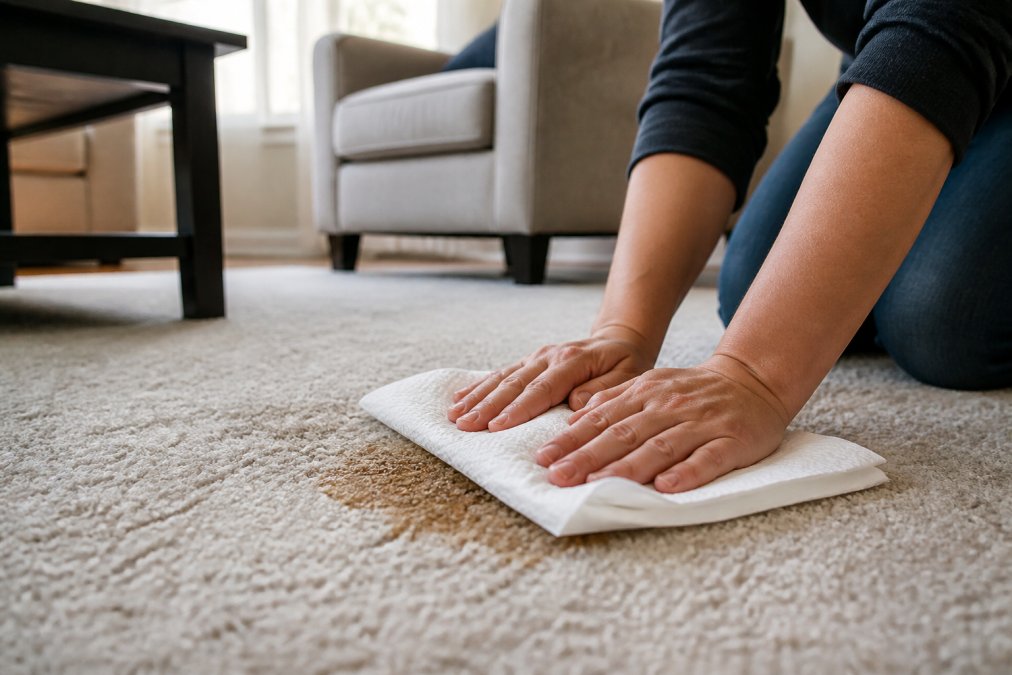
Step 1: Blot, Don't Rub
Place a thick layer of white paper towels or a clean white cloth directly over the wet area and press down firmly. Stand on it if the stain is large. Rubbing spreads urine crystals outward, pushes liquid deeper into fibers, and can fray the pile. Blot from the outside edge inward, working toward the center to prevent spreading. Repeat with fresh paper towels until you've absorbed as much liquid as possible.
Step 2: Apply Your Cleaning Solution
Mix one cup of warm water with one tablespoon of dishwashing detergent and one tablespoon of white vinegar. Apply this mixture sparingly to the stained area, working it gently into the carpet fibers with a damp cloth. Avoid soaking the carpet; excess moisture encourages mold growth and saturates the padding further.
Alternatively, apply an enzyme-based cleaner per the product's instructions. Enzyme cleaners are more effective for pet urine because they break down uric acid compounds at a molecular level rather than just masking odor (peer-reviewed research). Let the solution dwell for the recommended time.
Step 3: Rinse and Extract
Rinse the treated area with cold water to remove cleaning solution residue, which attracts dirt over time. Blot again thoroughly to pull out the rinse water. If you have a wet-vac or carpet extractor, use it to pull liquid from deeper in the carpet pile. Run it over the area several times, then allow the carpet to air dry completely with good ventilation.
How to Remove Old Urine Stains from Carpet
Dried stains are a different problem. The urine has bonded with carpet fibers, uric acid has crystallized, and odor compounds are locked in. Standard cleaning solutions often fall short.
Locating Dried Stains with a UV Light
A UV flashlight reveals urine stains that are invisible in normal lighting. Urine fluoresces under ultraviolet light, appearing as a yellow-green glow in a darkened room (the CDC). Scan the room slowly with lights off, marking each stain with tape before cleaning. You'll frequently find spots you didn't know existed.
Addressing Carpet Padding Saturation
When a pet urinates on carpet, liquid flows through the backing and into the padding beneath, which absorbs and holds urine like a sponge. When the carpet dries, urine wicks back up through the fibers. Surface cleaning won't solve the problem if the padding is saturated.
For heavily saturated padding, apply enough enzyme-based cleaner to reach the padding itself. Some cases require pulling back the carpet to replace the padding and treat the subfloor directly. This is where professional intervention becomes worthwhile.
Best Enzymatic Cleaner for Pet Urine: What to Look For
The best enzymatic cleaner contains live bacterial cultures or active enzyme compounds specifically formulated to break down uric acid, not just deodorize it. Many products labeled as "pet odor eliminators" use fragrance to mask the smell without addressing the underlying chemistry.
When evaluating an enzyme-based cleaner, look for:
- Active enzyme types listed: Protease breaks down protein, amylase targets starch, and lipase handles fats.
- Appropriate pH balance: A product with neutral to slightly alkaline pH works more effectively on dried stains.
- No added fragrance in the active formula: Fragrances can interfere with enzyme activity.
- Dwell time requirement: Effective enzyme cleaners need 10-15 minutes to work. Instant results are usually fragrance-based.
- Safe for carpet fibers: Check that the product is rated for your carpet type.
Apply the cleaner generously enough to match the depth of the original saturation.
| What to Look For | Why It Matters |
|---|---|
| Named enzyme types (protease, amylase) | Confirms active biochemical action on urine compounds |
| Neutral to slightly alkaline pH | Matches chemistry of dried, crystallized urine |
| Required dwell time (10-15 min) | Indicates real enzyme activity, not just fragrance |
| No masking fragrance in active formula | Prevents interference with enzyme performance |
| Colorfastness tested | Protects carpet fibers from discoloration |
How to Get Dog Pee Smell Out of Carpet
Getting dog pee smell out of carpet requires attacking the source of the odor. The ammonia-like smell comes from uric acid crystals that form as urine dries. Standard cleaners don't break down uric acid effectively.
The most reliable DIY approach:
- After blotting and rinsing, apply a generous layer of baking soda over the damp spot. Leave it for several hours or overnight.
- Vacuum thoroughly to remove all baking soda residue.
- Apply an enzyme-based cleaner and allow the full dwell time before blotting dry.
For persistent odors, mix one cup of 3% hydrogen peroxide with a teaspoon of dishwashing detergent. Apply to the stained area, let it sit for 10 minutes, then blot and rinse. Always do a colorfastness test first, as hydrogen peroxide can lighten some carpet fibers.
As the ASPCA's pet care resource library notes, repeated accidents in the same spot are common because pets detect residual urine odor far better than humans. Thorough odor elimination breaks this behavioral cycle.
Material-Specific Advice: Synthetic vs. Natural Fiber Carpets
Not all carpets respond the same way to cleaning solutions.
Synthetic carpets (nylon, polyester, olefin) are the most forgiving. They resist moisture absorption better than natural fibers and generally tolerate enzyme cleaners, hydrogen peroxide dilutions, and vinegar-based solutions. The main risk is over-wetting, which can delaminate the backing.
Natural fiber carpets (wool, sisal, jute, cotton) require a much more cautious approach. Wool is sensitive to alkaline cleaners and hydrogen peroxide, both of which can cause irreversible color damage. For wool:
- Avoid hydrogen peroxide entirely
- Use a pH-neutral enzyme cleaner specifically rated for wool
- Minimize moisture and dry quickly
- Never use white vinegar on wool
Sisal and jute are even more water-sensitive. Excessive moisture causes shrinking, distortion, and mold. For high-value natural fiber rugs, professional cleaning is almost always the safer choice.
When to Call a Professional for Pet Stain Removal
Some situations are genuinely beyond what DIY methods can address.
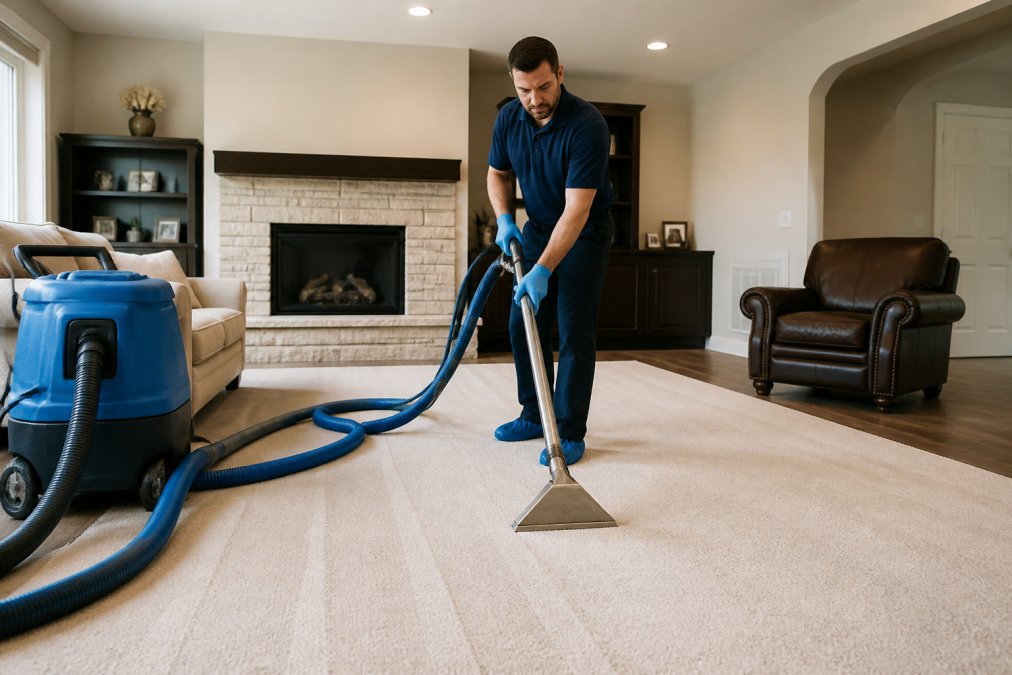
Call a professional when:
- The odor persists after two or more cleaning attempts. This almost always means the padding is saturated and needs professional-grade extraction or replacement.
- The stain covers a large area. Large-scale saturation requires commercial extraction equipment.
- You have natural fiber or high-value rugs. The risk of DIY damage is too high.
- You see discoloration or texture changes in the carpet. These are signs of fiber damage.
- The pet has had repeated accidents in the same area. The subfloor may be affected and padding replacement may be necessary.
Mighty Clean Services has been providing professional carpet and upholstery care since 2005, certified by the International Janitorial Cleaning Association (IJCSA). Our team uses state-of-the-art extraction equipment that reaches deep into carpet padding, addressing saturation that surface cleaning cannot touch.
Post-Cleaning Maintenance and Prevention
The best strategy for pet stains is reducing how often they become a serious problem.
Apply a carpet protector after deep cleaning. A fiber protector creates a barrier that slows liquid absorption, buying you more time to blot up accidents before they penetrate to the padding.
Establish pet-free zones for high-value rugs. Natural fiber rugs and antique carpets are too vulnerable to repeated accidents.
Clean accidents immediately, every time. Urine sitting for less than two hours is far easier to fully remove than dried stains.
Schedule periodic professional deep cleaning. Even with excellent spot treatment habits, carpet fibers accumulate pet dander and microscopic residue that regular vacuuming doesn't fully remove.
Pet stains are one of the most persistent carpet problems homeowners face, and DIY approaches that work for surface stains often leave the deeper issue untreated. Mighty Clean Services specializes in professional carpet and upholstery care, using commercial-grade extraction equipment to address saturation at the padding level. Our IJCSA-certified team handles everything from fresh accidents to long-standing odor problems across residential and commercial spaces. Book an appointment with Mighty Clean Services and get the thorough, lasting results that surface cleaning alone can't deliver.
Frequently Asked Questions
Does vinegar and baking soda remove old pet stains from carpet?
White vinegar and baking soda can reduce odor and lift surface residue from older pet stains, but they rarely eliminate urine crystals that have bonded deep in the carpet fibers or padding. The combination works best as a deodorizing spot treatment on lighter, more recent stains. For dried stains that have set over weeks or months, an enzyme-based cleaner is more effective because it breaks down the organic compounds that vinegar and baking soda cannot fully reach.
Are urine stains permanent on carpet?
Most pet urine stains are not permanent if treated correctly and promptly. The risk of permanent damage increases when urine soaks through carpet fibers into the padding and subfloor, where it dries and forms urine crystals. These crystals reactivate with humidity, causing recurring odor and visible discoloration. Stains treated within the first hour have the highest removal success rate. Older, deeply saturated stains may require professional extraction equipment to fully remove the stain and neutralize the odor.
How do you neutralize pet urine odor in carpet?
Neutralizing pet urine odor requires breaking down the uric acid crystals responsible for the smell, not just masking them. An enzyme-based cleaner is the most effective option because it digests the organic compounds in urine. For lighter odors, a solution of white vinegar and water followed by a baking soda application can help with deodorizing. Allow the baking soda to sit for several hours before vacuuming. If odor returns after cleaning, the urine has likely reached the carpet padding and professional deep cleaning may be needed.
When should you call a professional for pet stain removal?
Call a professional when DIY methods have failed more than once, when odor returns after cleaning, or when stains cover a large area. Urine that has penetrated the carpet padding and reached the subfloor requires commercial-grade wet-vac extraction that rental machines typically cannot match. Delicate or natural fiber carpets such as wool or silk also warrant professional handling to avoid discoloration or fiber damage. A certified cleaning service has the equipment and cleaning solutions to address deep saturation without damaging the carpet.