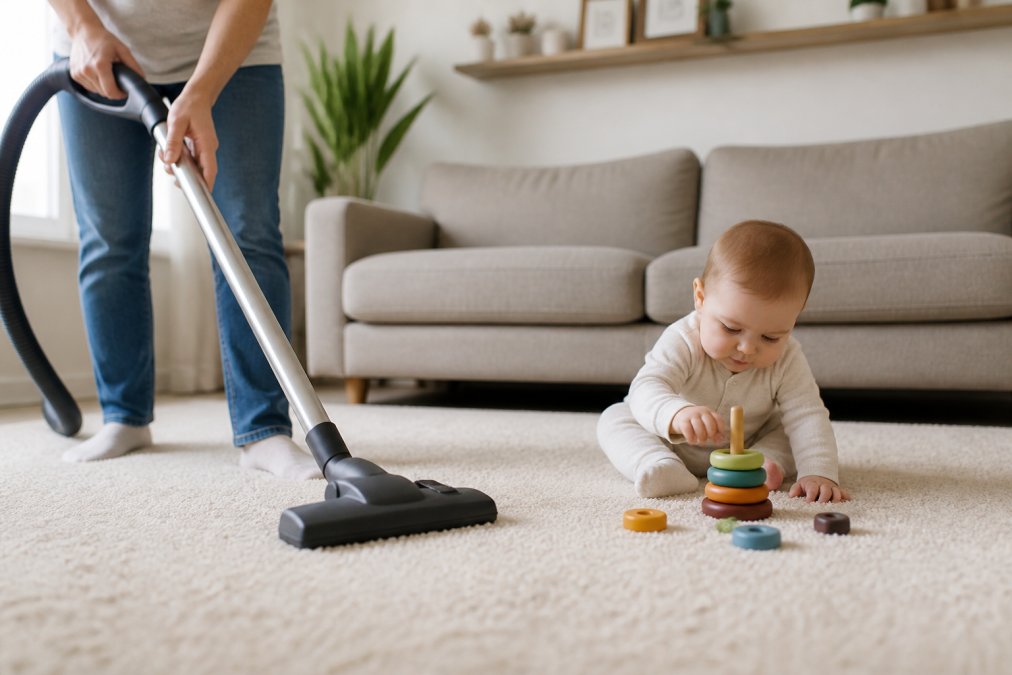
 ultimate-guide
Safe Carpet Cleaning for Newborn Babies: A Parent's Guide
Table of Contents
- Why Standard Carpet Cleaning Isn't Safe Enough for a Newborn
- Carpet Cleaning Chemicals to Avoid Around Newborns
- How Long to Wait After Carpet Cleaning for Baby
- The Best Baby Safe Carpet Stain Remover Options
- A Step-by-Step Safe Cleaning Method for Your Home
- DIY vs. Professional Safe Carpet Cleaning
- Frequently Asked Questions
Last Updated: September 9, 2026
Bringing a newborn home changes how you see every surface in your house, and the carpet is no exception. Safe carpet cleaning for newborn babies isn't just about removing visible dirt; it's about managing what you can't see, from dust mites to chemical residues that settle deep in the fibers. We've spent years helping families create healthier homes, and the evidence is clear: a newborn's developing respiratory system is far more sensitive to airborne irritants than an adult's. Below, we'll show you exactly how to clean your carpets safely, what chemicals to avoid, and how long to wait before letting your baby play on freshly cleaned floors.
Why Standard Carpet Cleaning Isn't Safe Enough for a Newborn
Most standard carpet cleaning methods prioritize stain removal over indoor air quality, often introducing volatile organic compounds (VOCs) and leaving behind sticky residues that attract new dirt almost immediately.
For a newborn, the concern is contact time. Babies spend hours on the floor during tummy time and the crawling stage, putting their mouths on fibers and breathing in the air just inches above the carpet. That thin layer of air is exactly where heavier particles and chemical off-gassing collect. The Environmental Protection Agency guidance on indoor air quality notes that indoor pollutant levels can be higher than outdoor levels, which matters when your baby's primary play zone is the floor.
Standard cleaning also tends to over-wet carpets. When carpets stay damp for long periods, they become a breeding ground for dust mites and mold spores, both of which are common triggers for respiratory irritation in infants.
Carpet Cleaning Chemicals to Avoid Around Newborns
The ingredient list on a carpet cleaning product tells you most of what you need to know. If you can't pronounce it, or if the label features a long list of synthetic compounds, treat it with suspicion. Knowing what to avoid requires understanding why these chemicals are risky for a newborn in the first place.
High-risk categories to avoid entirely:
- Fragrance and dyes: These are common skin and respiratory irritants. The term "fragrance" on a label can legally mask dozens of undisclosed chemicals, including phthalates, which are used to make scents last longer. Phthalates are endocrine disruptors, and a baby's developing system is particularly vulnerable.
- Products with high VOC content: Volatile organic compounds (VOCs) evaporate into the air at room temperature. Common VOCs in carpet cleaners include benzene, toluene, and xylene. The Environmental Protection Agency's list of volatile organic compounds includes many solvents that can cause eye, nose, and throat irritation, headaches, and nausea. For a newborn breathing in the air layer just above the carpet, these effects are magnified.
- Optical brighteners: These are fluorescent dyes that make carpets appear whiter by absorbing UV light and re-emitting it as visible blue light. They leave a residue that can transfer to skin and clothing, and they offer zero cleaning benefit.
- Solvents like perchloroethylene (perc): This is a dry-cleaning solvent that some carpet cleaning services still use. The National Institutes of Health's Hazardous Substances Data Bank classifies perc as a potential neurotoxicant. If a cleaning company mentions "dry cleaning" your carpet, ask specifically whether they use perc.
How These Chemicals End Up in Your Baby's Air
When a carpet is cleaned with a product containing VOCs, the chemicals don't disappear when the carpet dries. They continue to off-gas for days or even weeks. A 2020 study from the University of California, Berkeley's School of Public Health found that certain carpet cleaning products can release VOCs for up to 72 hours after application. For a newborn who spends hours on the floor, this off-gassing window is critical.
Recognizing High-Risk Ingredients on Product Labels
Learn to scan labels for specific terms rather than trusting marketing claims like "green" or "natural." The American Lung Association's guidance on household cleaning products recommends avoiding products that list "fragrance" generically, as this single term can mask hundreds of undisclosed chemicals.
Watch for these specific names:
- Phthalates: Often hidden within fragrance. Look for DEP, DBP, or DEHP on the ingredient list.
- Nonylphenol ethoxylates (NPEs): A surfactant that resists biodegradation and has been shown to mimic estrogen in laboratory studies. Some states have restricted their use in household products.
- Formaldehyde: Used as a preservative in some solutions. It's a known carcinogen and respiratory irritant.
- Quaternary ammonium compounds (quats): Common in disinfectants labeled "antibacterial." Quats are linked to asthma development when used frequently in indoor environments.
- 2-Butoxyethanol: A solvent that gives cleaning products their "sweet" smell. It's a respiratory irritant and is listed on California's Proposition 65 list of chemicals known to cause reproductive harm.
What to Look For Instead
When in doubt, choose a product that meets these three criteria: fragrance-free, dye-free, and pH-neutral. These three qualifiers eliminate the majority of irritants found in standard formulas. Additionally, look for the EPA's Safer Choice label, this certification means every ingredient has been reviewed for human and environmental safety. Products carrying the Green Seal certification are also independently verified to meet rigorous health standards.
A practical test: after cleaning a small area, put your face close to the carpet and inhale deeply. If you detect any chemical odor, the product is still off-gassing. Truly safe products should be virtually odorless once dry.
How Long to Wait After Carpet Cleaning for Baby
The safest answer is to wait until the carpet is completely dry to the touch, which typically takes 6 to 12 hours with professional extraction equipment. Rushing this step is the most common mistake parents make, because a damp carpet transfers residues and moisture directly to your baby's skin and clothing.
Variables That Affect Drying Time
Several factors extend or shorten the drying window:
- Humidity: High outdoor humidity slows evaporation considerably
- Ventilation: Opening windows and running fans can cut drying time nearly in half
- Cleaning method: Shampooing leaves more moisture than hot water extraction
- Carpet thickness: Plush, high-pile carpets hold significantly more water than low-pile berber
The Best Baby Safe Carpet Stain Remover Options
For everyday spots and stains, you don't need harsh chemicals. The best baby safe carpet stain remover is often one you can mix yourself from ingredients you already have.
Effective DIY spot treatment:
- Blot the stain immediately with a clean white cloth, working from the edges inward
- Mix one tablespoon of mild, fragrance-free dish soap with two cups of warm water
- Apply the solution sparingly, then blot again
- Rinse the area with plain water and blot dry
For stubborn organic stains like formula or baby food, a light sprinkle of baking soda can help absorb moisture and neutralize odors before blotting. Always test any solution on a hidden corner of the carpet first to confirm it won't cause discoloration.
A Step-by-Step Safe Cleaning Method for Your Home
A thorough whole-room clean requires more than spot treatment. This method balances deep cleaning with chemical safety for your newborn's primary play areas.
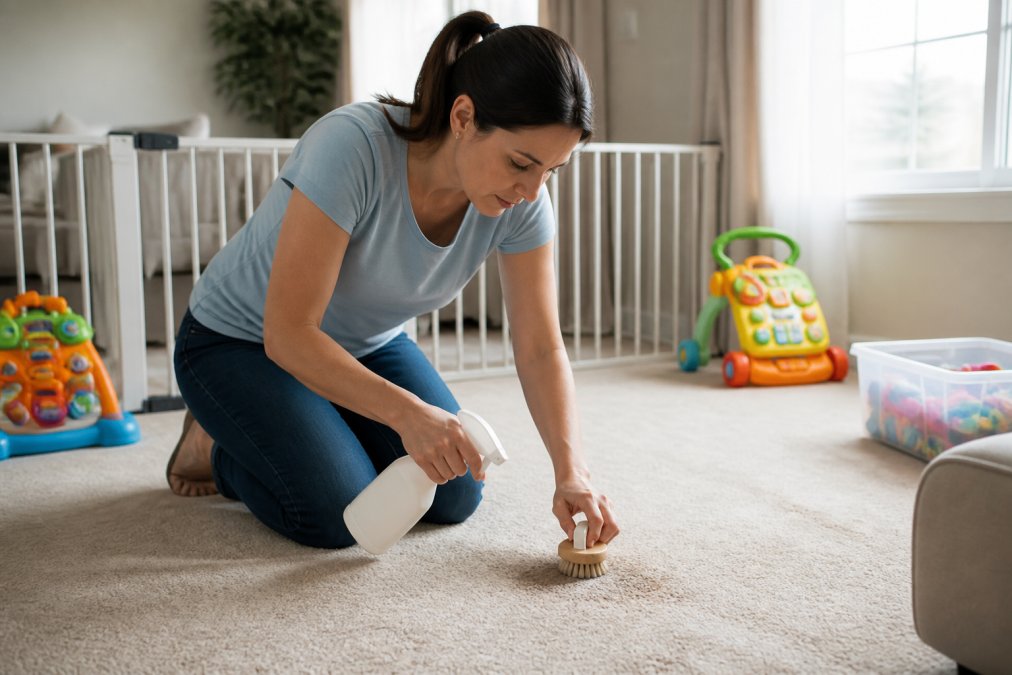
Step 1: Vacuum thoroughly. Use a vacuum with a HEPA filter to capture fine particles and allergens. Vacuum slowly, making multiple passes in different directions to lift embedded dirt.
Step 2: Pre-treat visible stains. Apply your DIY spot treatment and blot gently. Do not scrub, as rubbing pushes the stain deeper into the carpet fibers.
Step 3: Choose your cleaning method. For maintenance cleaning, a steam cleaner using only hot water is the gentlest option. For deeper soil, use a pH-neutral, fragrance-free carpet shampoo.
Step 4: Rinse thoroughly. This step is critical. Run a plain hot water pass after shampooing to flush out detergent residue. Leftover soap acts as a magnet for new dirt.
Step 5: Maximize airflow. Set up fans and open windows immediately after cleaning. The goal is to return the carpet to a dry state within 6 to 12 hours.
DIY vs. Professional Safe Carpet Cleaning
DIY rental machines seem economical, but they often fail in two critical areas: water temperature and suction power. Rental units rarely heat water hot enough to sanitize, and their weak suction leaves carpets wetter than they should be, prolonging drying time and risking residue buildup.
Professional equipment operates at higher temperatures and far stronger extraction, pulling out more water and more soil. This makes a meaningful difference for allergen reduction. The Asthma and Allergy Foundation of America resources on dust mite control highlights that reducing dust mite populations requires removing their food source, which means deep extraction that reaches the base of the carpet pile.
Consider professional cleaning when:
- Your baby is starting to crawl or spend significant time on the floor
- The carpet hasn't been deep cleaned in over 6 months
- You notice musty odors or visible staining that DIY methods can't remove
- You want to avoid the guesswork of chemical selection entirely
How to Verify Your Carpet Is Truly Residue-Free After Professional Cleaning
Most parents take a cleaning company's word that the job is done safely. But there are concrete ways to verify that no chemical residue remains before you let your baby crawl on the carpet. This is the step almost no cleaning guide covers, and it's the one that matters most for your newborn's health.
The White Cloth Test: After the carpet has fully dried, press a clean, damp white cloth firmly into the carpet pile for 10 seconds. Remove it and inspect. If you see any discoloration, film, or residue on the cloth, the carpet was not rinsed thoroughly. A properly cleaned carpet should transfer nothing to the cloth.
The pH Strip Test: Purchase pH test strips at any pharmacy or pool supply store. Moisten a small area of the carpet with distilled water, then press a pH strip against the fibers for 30 seconds. A neutral reading of 6.5 to 7.5 indicates the carpet is free of alkaline detergent residue. Readings above 8 suggest soap residue remains; readings below 6 may indicate acidic spotting agents were left behind.
The Odor Test: After the carpet is completely dry, get down to floor level and take a deep breath. If you smell anything other than the carpet's natural fiber scent, the cleaning solution is still off-gassing. Many professional-grade products contain masking fragrances that only become detectable once the carpet dries. If you smell anything, request that the company return for an additional plain-water rinse pass.
The Drying Time Audit: Ask your cleaning company for their specific drying time estimate in writing. Industry standard for truck-mounted hot water extraction is 6 to 12 hours. If a company claims 2 hours, they're likely using chemical accelerants or leaving carpets too wet. If they claim 24 hours, their equipment may be underpowered. A reputable company will give you a specific window and explain the variables that affect it.
Questions to Ask Before Hiring a Professional
Before you book any carpet cleaning service, ask these five questions directly:
- "What specific cleaning solutions do you use, and can you provide a Safety Data Sheet (SDS) for each?" A legitimate company will provide these documents without hesitation. The SDS lists every chemical in the product, including fragrance components.
- "Do you use truck-mounted or portable equipment?" Truck-mounted units heat water to 200°F+ and generate suction of 15+ inches of water lift. Portable units typically run cooler and weaker.
- "How many rinse passes do you perform?" The answer should be at least one dedicated plain-water rinse pass after the cleaning solution pass. Some companies skip this to save time.
- "What is your guaranteed drying time?" A specific answer like "8 to 10 hours with fans running" is better than a vague "it depends."
- "Are your technicians certified?" Look for certification from the Institute of Inspection, Cleaning and Restoration Certification, which requires training in proper extraction and chemical handling.
That's where a certified team makes the difference. Mighty Clean Services has been providing professional carpet care since 2005, and our technicians are certified by the International Janitorial Cleaning Association (IJCSA). We use state-of-the-art extraction equipment and pH-balanced, fragrance-free solutions designed to minimize chemical exposure, so your carpets come out clean, dry, and safe for your family. We'll provide our SDS documents before we start, perform a dedicated rinse pass, and give you a specific drying time estimate.
Frequently Asked Questions
Is it safe to use steam cleaning in a room with a newborn?
Yes, steam cleaning is generally safe because it uses high heat to sanitize without harsh chemicals. The main concern is drying time. Ensure the room is completely dry before bringing your newborn back in, as damp carpets can harbor mold and dust mites. Allow 6 to 12 hours of drying time and keep the room well-ventilated with fans and open windows.
What is the safest carpet cleaning method for a crawling baby?
Hot water extraction (steam cleaning) with a fragrance-free, non-toxic, pH-neutral solution is the safest method. This method flushes out surface contaminants and allergens from deep within the carpet fibers. Be sure the technician uses a baby-safe product and that the carpet is fully dry before your baby crawls on it.
How do I get rid of baby sick smell from carpet without harsh chemicals?
Act fast. Blot the area with a clean cloth, then apply a small amount of mild dish soap mixed with water. Rinse with a cloth dipped in plain water and blot dry. Sprinkle baking soda over the area once it is damp, let it sit until completely dry, and vacuum it up to neutralize odors.
Does professional carpet cleaning remove allergens that affect newborns?
Yes. Professional hot water extraction can remove dust mites, pet dander, and other allergens trapped in carpet fibers. Using a HEPA-filtered vacuum and a hypoallergenic cleaning solution helps improve indoor air quality. Ask your provider if they use fragrance-free products and how long the drying time will be to ensure safety for your baby.