 how-to
Safe Cleaning Methods for Delicate Upholstery: 2026 Guide
Table of Contents
- Why Delicate Upholstery Needs a Different Approach
- Upholstery Cleaning Codes Explained: What S, W, S/W, and X Mean
- What You'll Need Before You Start Cleaning
- Best Tools for Delicate Fabric Cleaning
- Step-by-Step: Safe Cleaning Methods for Delicate Upholstery
- How to Remove Pet Stains from Silk Upholstery
- Common Mistakes That Damage Delicate Fabrics
- When to Call a Professional for Delicate Upholstery
- Frequently Asked Questions
Last Updated: September 14, 2026
Why Delicate Upholstery Needs a Different Approach
Delicate upholstery is any fabric that loses color, shape, or structural integrity when exposed to excess water, heat, or alkaline cleaners. Silk, velvet, linen, and some synthetic blends fall into this category because their fibers or dyes react badly to methods that work on durable cotton or microfiber. This guide from Mighty Clean Services covers safe cleaning methods for delicate upholstery.
The core problem is moisture. Delicate fibers absorb water unevenly, causing water rings, shrinkage, and pile crushing, while harsh alkaline solutions strip dyes and leave stiff patches. The same shampoo you use on a family-room sofa can ruin a silk cushion in minutes.
Below, we break down fabric codes, spot testing, tools, and a step-by-step process: identify first, test second, clean last.
Upholstery Cleaning Codes Explained: What S, W, S/W, and X Mean
Upholstery cleaning codes are single-letter labels, usually printed on a tag stapled to the furniture's underside, that tell you which cleaning method a fabric can tolerate. Ignoring them is the fastest way to void a warranty or permanently damage a textile. For delicate fabrics, you also need to know where to find them, how to read them against the fiber, and what to do when the tag is gone.
Where to Find the Code
Check these locations in order:
- Under the seat cushions, on the deck or the cushion's own underside
- Stapled to the back panel or the bottom dust cover
- Inside a zippered cushion cover, sewn into a seam
- On the furniture's original paperwork or the retailer's product page
If you find a tag with a letter and a phrase like "cleaning code" or a small symbol, that is the one that matters. Photograph it before cleaning so you can refer back without flipping the furniture again.
What Each Code Actually Permits
- W, Water-based cleaners are safe: a pH-neutral upholstery shampoo, a water-and-mild-detergent mix, or a low-moisture extraction tool. This is the most forgiving code, but "water-safe" still does not mean "soak it."
- S, Solvent-based cleaners only. Water causes rings, shrinkage, and dye bleed on these fibers. Silk, some rayons, and many velvets carry an S code. Clean with a dry-cleaning solvent, not a water-based shampoo.
- S/W, Either water-based or solvent cleaners are acceptable, common on blended fabrics. Choose based on the stain: water-based for protein stains like food, solvent for oil-based stains like grease or cosmetics.
- X, Vacuum or light brush only. No liquid cleaner of any kind. These fabrics are usually viscose, some silks, and certain novelty weaves. If you spill on an X-coded piece, blot dry and call a professional.
- No code at all, Treat the piece as S until a professional confirms otherwise. This is the safe default, not a guess.
Reading the Code Against the Fiber
The code tells you what the fabric can survive, but the fiber tells you why. Silk is protein-based and loses strength when wet, so it is almost always S. Linen absorbs water unevenly and can shrink or develop water rings, so it is often S or S/W. Velvet's pile crushes under moisture and pressure regardless of code, so even a W-coded velvet needs a light touch. Wool felts with heat and agitation, behaving like an S fabric even when coded W.
When the code and the fiber seem to disagree, follow the more restrictive one. A W-coded silk cushion still should not be soaked.
When the Tag Is Missing or Illegible
Do not guess. Work through this sequence:
- Look for a second tag inside cushion covers or under the deck.
- Check the retailer's website or the manufacturer's product listing, many publish the cleaning code.
- Call the manufacturer with the model number if you have it.
- If none of that works, treat the piece as S and test a solvent-based cleaner on a hidden area first.
According to the Carpet and Rug Institute's cleaning guidance, matching the cleaning agent to the fiber is the single most important step in preventing damage. The code is how you do that match without guessing.
A Quick Code-to-Method Cheat Sheet
| Code | Safe Method | Typical Delicate Fibers | Never Do |
|---|---|---|---|
| W | pH-neutral water-based shampoo, low moisture | Some linens, cotton blends | Soak or scrub |
| S | Solvent-based cleaner on a cloth | Silk, rayon, many velvets | Apply water |
| S/W | Either, matched to the stain | Blended fabrics | Mix methods on the same spot |
| X | Vacuum or soft brush only | Viscose, novelty weaves | Any liquid |
The code is the manufacturer's statement of what the fabric can survive. Read it before you touch the fabric, and when it is missing, default to the most protective method.
What You'll Need Before You Start Cleaning
Gather your supplies before you touch the fabric. Stopping mid-clean to hunt for a cloth means the solution sits on the fiber longer than it should.
- A vacuum with an upholstery attachment and a soft-bristled brush
- pH-neutral upholstery shampoo or a solvent-based cleaner matched to the fabric code
- Distilled water (tap water minerals can leave rings on silk and linen)
- White microfiber cloths, at least four
- A spray bottle
- A small hidden test area you can reach
Spot Testing Your Cleaning Solution
Spot testing means applying a small amount of cleaner to a hidden area and waiting to confirm no color bleed, ring, or texture change occurs. Test on the back or underside of the cushion, never the seat top.
Apply solution to a white cloth, not directly to the fabric. Blot the hidden area, wait ten minutes, then check for color transfer and any change in feel. If the cloth picks up dye or the fabric stiffens, switch to a solvent-based product or call a professional.
Best Tools for Delicate Fabric Cleaning
The best tools for delicate fabric cleaning are a soft-bristled brush, a vacuum upholstery attachment, pH-neutral solution, and plenty of microfiber cloths. Aggressive tools cause more damage than dirt does.
A stiff brush pulls loops and crushes velvet pile, and a wet/dry shop vacuum can distort the filling. Stick to gentle agitation and controlled moisture. If you are coming from a rental-machine mindset, expect this process to feel slower and lighter-touch, that is the point.
| Tool | Best For | Avoid On |
|---|---|---|
| Soft-bristled brush | Lifting dust from velvet, linen | Silk, loose weaves |
| Upholstery attachment | Pre-clean vacuuming | Wet extraction |
| pH-neutral shampoo | W and S/W fabrics | S-coded fabrics |
| Solvent cleaner | S-coded silk, some velvets | X-coded fabrics |
| Microfiber cloths | Blotting, drying | Scrubbing motion |
Step-by-Step: Safe Cleaning Methods for Delicate Upholstery
Safe cleaning methods for delicate upholstery follow one rule above all others: control the moisture and never scrub. The process below works on most S/W and W fabrics and takes about 30 to 45 minutes per cushion once you are set up. Drying is where most damage happens, so it gets detailed treatment at the end.
Step 1: Vacuum with a Soft-Bristled Brush
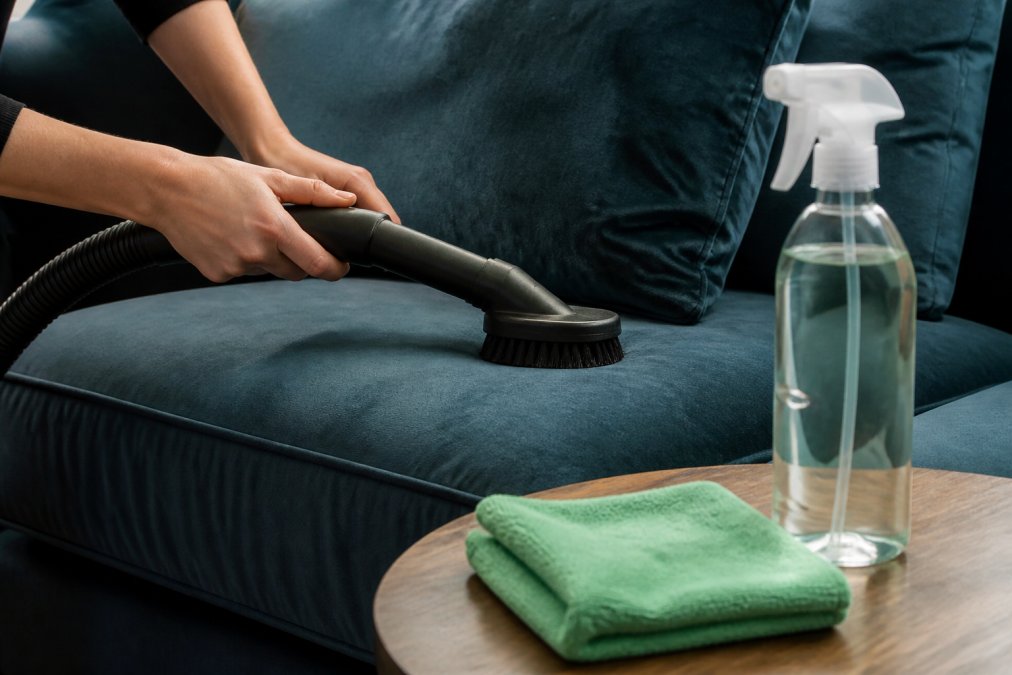
Vacuuming removes the dry soil that turns into mud the moment you add liquid. Use the upholstery attachment on low suction and a soft-bristled brush to lift dust from the surface and seams, working in overlapping passes without pressing into the fabric. For velvet, vacuum in the direction of the nap only. For loose weaves, use softer bristles or the bare attachment.
Step 2: Apply a pH-Neutral Solution and Blot
Apply your tested solution to a cloth, not the fabric, then blot from the outside of the stain toward the center to prevent it spreading into a larger ring. Rinse by blotting with a cloth dampened with distilled water, then blot dry. Never rub; rubbing distorts the weave and pushes soil deeper. Work in small sections, finishing one before starting the next so no area stays wet longer than necessary.
Step 3: Control Moisture and Dry Correctly
Drying is where delicate fibers are won or lost. Water rings, shrinkage, mildew in the filling, and pile crushing all happen during drying, not cleaning. The goal is to remove moisture fast without heat or direct airflow that distorts the fiber.
Blot first, then air-dry. Press a dry white microfiber cloth onto the damp area, swapping to a dry section as it saturates, until the cloth comes away barely damp. Then air-dry away from direct sun and heat.
Use indirect airflow. Point a fan at the wall or ceiling so air circulates rather than blasting the fiber, direct high-velocity air can distort loose weaves and push pile in one direction.
Never use a hair dryer or space heater. Heat sets stains, shrinks wool and silk, and can scorch synthetic blends (cleaninginstitute.org). Room-temperature air movement is enough.
Elevate cushions. Prop damp cushions on their edges so air reaches both sides; a cushion left flat dries unevenly and can grow mildew in the filling within 24 to 48 hours in a humid room.
Reset the nap while damp. For velvet, brush the pile in one direction while it is still slightly damp to reset the nap and prevent crushing. Use a soft brush or your hand, and work in the direction the pile naturally falls.
Watch for water rings. A ring means moisture wicked to the edge of the wet area and carried soil with it. Re-dampen the entire area evenly with distilled water and dry again with indirect airflow. Do not spot-treat the ring alone, that makes it worse.
Give it 12 to 24 hours. Delicate fabrics dry slowly. Do not put cushions back, sit on the piece, or cover it until it is fully dry to the touch on both sides. Covering a damp cushion traps moisture and invites mildew.
Step 4: Post-Clean Inspection
Once fully dry, check three things: color uniformity (no rings or faded patches), texture (no stiffness or crushed pile), and odor (no musty smell). If any is off, the cause is almost always uneven moisture or too much solution. Re-dampen evenly and dry again, or call a professional if the fabric has stiffened.
How to Remove Pet Stains from Silk Upholstery
Pet stains on silk upholstery require a solvent-based approach, because silk is almost always coded S and water will leave a permanent ring. Start by lifting any solid waste with a gloved hand, then blot the liquid with a dry white cloth.
Apply a small amount of solvent-based cleaner to a clean cloth and blot the stain from the edges inward. Do not pour or spray directly onto the silk. Work in small sections and swap to a clean part of the cloth as it picks up soil. For odor, a light dusting of baking soda left for fifteen minutes before vacuuming can help, but test it on a hidden area first. According to the American Cleaning Institute's stain guidance, matching the cleaner to the fiber type prevents the discoloration that makes pet stains permanent.
If the stain has set or the silk is vintage, stop and call a professional. Silk has almost no margin for error.
Common Mistakes That Damage Delicate Fabrics
The biggest mistake in delicate upholstery care is treating every fabric the same. Using a grocery-store rental machine on an S-coded cushion causes shrinkage and rings from the water alone. Over-wetting is another: more solution means a longer dry time and higher risk of mildew in the filling, not a deeper clean.
Other frequent errors:
- Scrubbing instead of blotting, which distorts the weave
- Using an alkaline all-purpose cleaner on silk or wool
- Drying in direct sunlight, which fades dyes unevenly
- Cleaning the whole piece without a spot test
When to Call a Professional for Delicate Upholstery
Call a professional when the fabric is coded S, the piece is antique or high-value, the stain has set, or you are unsure of the fiber content. Silk, vintage velvet, and anything with a warranty you want to keep are safer in a pro's hands.
At Mighty Clean Services, our certified team has handled delicate upholstery since 2005, using equipment and products matched to each fabric. We are IJCSA-certified and specialize in residential and commercial upholstery care. If rental machines or another provider left stains that came back, the issue is usually method, not effort, we control moisture and match the solution to the fiber so the result holds.
For stubborn stains, allergen and pet dander removal, or a piece you simply do not want to risk, book an appointment and let a certified technician handle it.
Frequently Asked Questions
What is a safe and non-toxic upholstery cleaner for delicate fabrics?
A pH-neutral solution made from a few drops of mild dish soap and distilled water is safe for most delicate upholstery. For natural fibers like silk or linen, plain distilled water with a tiny amount of white vinegar works well. Always spot test on a hidden area first. Avoid harsh chemicals, bleach, and enzyme cleaners unless the fabric code allows it. If you're unsure, a professional can recommend the right product for your specific fabric.
Can I use Dawn dish soap on silk or velvet upholstery?
Dawn dish soap is a mild detergent, but it is not recommended for silk or velvet. Silk is a protein fiber that can be damaged by even mild soaps, leading to water rings and loss of sheen. Velvet can mat or crush when wet. For these fabrics, use a dry cleaning solvent or call a professional. Always check the cleaning code first. If the code is S, only solvent-based cleaners are safe.
How do I identify the cleaning code on my furniture?
Check under the seat cushions or on the bottom of the furniture for a tag with a letter code: W (water-based cleaners), S (solvent-based cleaners only), S/W (either water or solvent), or X (vacuum only, no liquids). If the tag is missing, test a hidden area with a small amount of water and mild soap. If the fabric darkens or wrinkles, use a solvent instead. When in doubt, consult a professional upholstery cleaner.
How often should delicate upholstery be professionally cleaned?
Most delicate upholstery benefits from professional cleaning every 12 to 18 months. High-traffic pieces or homes with pets and children may need cleaning every 6 to 9 months. Regular vacuuming and prompt stain removal extend the time between deep cleanings. If you notice lingering odors, dullness, or water rings that won't lift, it's time to call a professional.
Delicate upholstery rewards patience over force, and the difference between a clean cushion and a ruined one usually comes down to one decision: matching your method to the fabric. When the piece is silk, vintage, or simply too valuable to gamble on, Mighty Clean Services brings certified expertise, fabric-matched products, and moisture-controlled equipment to the job. Get started with Mighty Clean Services and protect the furniture you love while getting it genuinely clean.