 blog
blog
Commercial Carpet Maintenance for Offices: 2026 Guide
Table of Contents
- Why Commercial Carpet Maintenance for Offices Decides Your Floor's Lifespan
- Commercial Carpet Cleaning Frequency: Matching the Schedule to Your Space
- Preventative Carpet Maintenance for Businesses: Daily Habits That Cut Deep-Cleaning Costs
- Office Carpet Stain Removal Guide: Handling Coffee, Ink, and Food Spills
- Choosing Between Professional Service and DIY Carpet Care
- Indoor Air Quality and Green Cleaning in Office Carpet Maintenance
- What Commercial Carpet Maintenance Costs and How to Budget for It
- Frequently Asked Questions
Last Updated: September 24, 2026
Why Commercial Carpet Maintenance for Offices Decides Your Floor's Lifespan
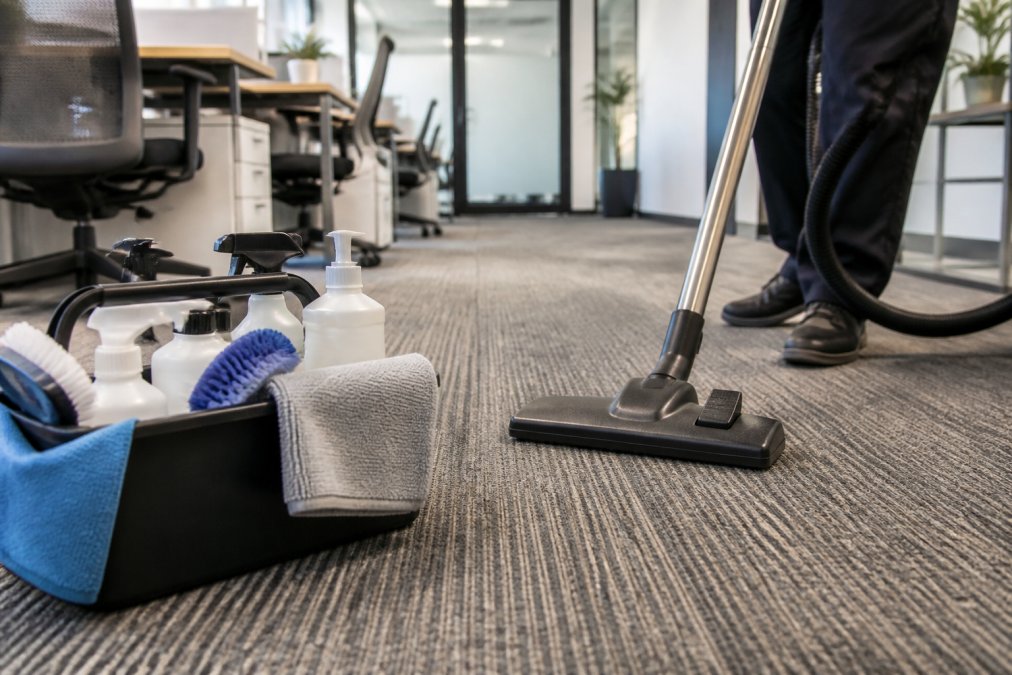
Commercial carpet maintenance for offices is the scheduled care, cleaning, and protection of workplace flooring to extend its usable life and keep the space healthy. At Mighty Clean Services, we have handled both residential and commercial carpet care since 2005, and the pattern is consistent: offices that treat carpet as a maintenance line item replace it years later than offices that only call someone after a spill.
That gap comes down to soil. Every square foot of office carpet collects tracked-in grit, paper dust, and food crumbs daily. Those particles work like sandpaper against synthetic fibers each time someone walks across them. Left alone, the damage is permanent.
Below, we break down cleaning frequency, daily habits, stain removal, and budgeting so you can build a plan that fits your space.
Commercial Carpet Cleaning Frequency: Matching the Schedule to Your Space
Most offices need professional hot water extraction every 6 to 12 months, with high-traffic areas cleaned more often. The right interval depends on foot traffic, square footage, and whether you already run a daily vacuum routine.
How Traffic Lanes and Square Footage Set Your Cleaning Cycle
Traffic lanes, the visible paths people walk between desks, doors, and elevators, wear out first. They also hold the most soil load. Watch those lanes rather than the whole floor.
| Office Type | Daily Vacuum | Spot Treatment | Deep Cleaning |
|---|---|---|---|
| Small office, low traffic | 3-5x weekly | As needed | Every 12 months |
| Open-plan office, medium traffic | Daily | As needed | Every 9 months |
| Lobby or reception, high traffic | Daily, twice in entries | Daily walk-through | Every 6 months |
Square footage pricing usually reflects this. Larger open floors take longer to prespray and extract, so providers quote by area plus condition.
Preventative Carpet Maintenance for Businesses: Daily Habits That Cut Deep-Cleaning Costs
Preventative carpet maintenance for businesses is the cheapest part of your program. Daily vacuuming with proper filtration, walk-off mats, and quick spot kits reduce how much soil reaches the carpet backing, which is where deep cleaning gets expensive.
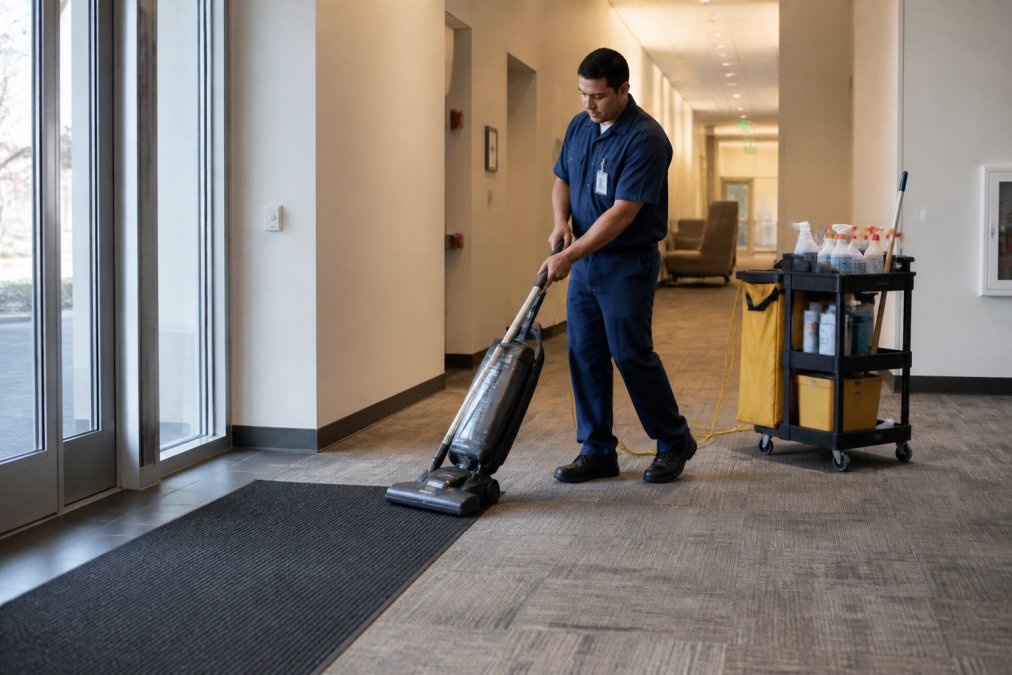
Vacuum Filtration, Walk-Off Mats, and Spot Kits
Three habits carry most of the weight:
- Vacuum filtration: Use machines with HEPA filtration and dual-motor heads. Cheap vacuums push fine dust back into the air and into the pile.
- Walk-off mats: Place commercial-grade mats at every entrance, long enough for four to five steps. They capture grit before it reaches carpet.
- Spot kits: Stock neutralizing solution, spotting agents, and clean white cloths at each floor. Fresh spills lift easily; set stains do not.
Office Carpet Stain Removal Guide: Handling Coffee, Ink, and Food Spills
Blot, do not rub. That single rule prevents more permanent damage than any product on the shelf. Rubbing pushes the spill deeper into the fiber pile and spreads the stain sideways.
How pH Balance and Dwell Time Change the Outcome
Match the cleaner to the stain:
- Coffee and tea: Blot, then apply a mild acidic solution. Coffee is a dye stain, so treat it fast.
- Ink: Use an isopropyl-based spotting agent on a white cloth, working from the outside in.
- Grease and food: Apply a degreaser, allow dwell time, then blot with warm water.
- Gum or wax: Freeze with an aerosol coolant, shatter, then vacuum the fragments before treating residue.
- Blood or protein: Use a cold-water enzymatic cleaner. Hot water sets protein stains permanently.
pH balance matters because synthetic fibers and carpet backing react to what you leave behind. Alkaline residue attracts new soil, which is why rinsing after treatment is not optional.
Carpet Tile Workflows: The Angle Most Guides Skip
Most modern offices are floored in carpet tile, not broadloom, and tile changes the stain playbook in three ways.
A Practical Spot Kit for Each Floor
Stock one kit per floor so spills get handled in minutes, not hours:
- Neutral pH pre-spray
- Acidic coffee and tea spotter
- Isopropyl-based ink spotter
- Enzymatic protein spotter
- Aerosol coolant for gum
- White cotton towels (dyed towels can transfer color)
- A small weighted pad for wicking
- Nitrile gloves
Choosing Between Professional Service and DIY Carpet Care
Professional service offers controlled drying. Rental machines and consumer units may leave more moisture behind, which means longer drying windows and a higher risk of wicking, where the stain reappears as the carpet dries.
- Professional: Truck-mounted hot water extraction, controlled drying, trained operators, documented results.
- DIY: Lower upfront cost, higher labor hours, uneven results, longer downtime.
Indoor Air Quality and Green Cleaning in Office Carpet Maintenance
Carpet acts as a filter for your office. It traps allergens, pet dander from visiting dogs, and fine particulates, which is good, until the carpet is never cleaned and starts releasing them back into the air.
What Commercial Carpet Maintenance Costs and How to Budget for It
Pricing depends on square footage, traffic level, fiber type, and condition, so no honest provider quotes a flat number without a walkthrough. Pricing depends on quantity, dates, and delivery. What you can do is budget against ranges and build a capital plan around them.
Typical Cost Ranges by Service Type
Most offices see the following patterns when they request quotes. Treat these as planning ranges, not bids:
| Service | Typical Unit | Common Range | Notes |
|---|---|---|---|
| Hot water extraction (deep clean) | Per sq ft | $0.20 - $0.40 | Higher end for heavily soiled or tight-access floors |
| Encapsulation cleaning | Per sq ft | $0.15 - $0.30 | Faster dry time, good for maintenance cycles |
| Low-moisture bonnet cleaning | Per sq ft | $0.10 - $0.20 | Interim cleaning between extractions |
| Spot treatment visit | Per visit | $75 - $200 | Depends on travel and number of spots |
| Carpet tile replacement | Per tile | $3 - $8 installed | Includes labor and matching tile |
| Walk-off mat program | Per mat, per month | $15 - $40 | Rental, laundering, and rotation included |
The ROI Math Facility Managers Should Run
Commercial-grade broadloom or carpet tile runs roughly $3 to $8 per sq ft installed, depending on backing, fiber, and adhesive. A 10,000 sq ft floor therefore represents $30,000 to $80,000 in capital expenditure, plus disposal and downtime.
Three levers drive the return:
- Frequency discipline. Skipping a cycle lets soil reach the backing, where extraction cannot fully recover it. That is the point where replacement timelines collapse.
- Tile-level repair. Carpet tile lets you swap individual squares instead of replacing a run. A $5 tile beats a $5,000 section every time.
- Entryway control. Walk-off mats capture the majority of tracked-in soil in the first few steps. Every dollar spent on mats reduces deep-cleaning labor.
How to Structure the Budget
| Budget Line | What It Covers | How to Plan |
|---|---|---|
| Routine | Vacuuming, spot kits, mats | Fixed monthly labor cost |
| Deep cleaning | Hot water extraction, encapsulation | Per-visit quote, 1-2x yearly |
| Repairs | Carpet tiles, transition strips | Reserve fund for replacements |
For a firm quote on your space, request an assessment through Mighty Clean Services rather than guessing from a per-square-foot average. A walkthrough will price condition, access, and fiber type accurately.
Frequently Asked Questions
How often should commercial office carpets be professionally cleaned?
Frequency depends on traffic. High-traffic zones like lobbies and hallways often need hot water extraction every 3 to 4 months, while private offices and low-traffic areas can go 6 to 12 months. A commercial carpet maintenance plan should combine daily vacuuming, quarterly deep cleaning, and spot treatment as spills happen. Spaces with pets, food service, or heavy foot traffic need shorter intervals to prevent soil from grinding into the fibers.
What is the best method for maintaining high-traffic office carpet?
Hot water extraction remains the standard for deep cleaning because it flushes soil from the carpet backing. Between extractions, low-moisture methods like encapsulation or bonnet cleaning handle surface soil and shorten drying time. Pair these with daily vacuuming using HEPA filtration, walk-off mats at entrances, and quick spot treatment. This layered approach keeps soil load down and protects fiber pile between scheduled deep cleans.
How do you remove common office stains from commercial carpet?
Blot, don't rub. For coffee or tea, apply a spotting agent mixed to the correct pH, let it dwell briefly, then blot from the outside in. Ink needs an alcohol-based spotter; food grease responds to a citrus or solvent-based product. Always test in a hidden area first, especially on synthetic fibers, and avoid over-wetting because moisture trapped in the backing can cause odor and delamination. Call a professional for set-in or large stains.
How does carpet maintenance affect indoor air quality in offices?
Carpet traps dust, pollen, and pet dander, which keeps those particles out of the breathing zone until the carpet is disturbed. Regular vacuuming with HEPA filtration and scheduled hot water extraction remove that trapped soil instead of recirculating it. Neglected carpet becomes a reservoir that releases allergens with every footstep. For offices with allergy-sensitive staff, a preventative maintenance schedule plus proper drying after cleaning can contribute to better indoor air quality.